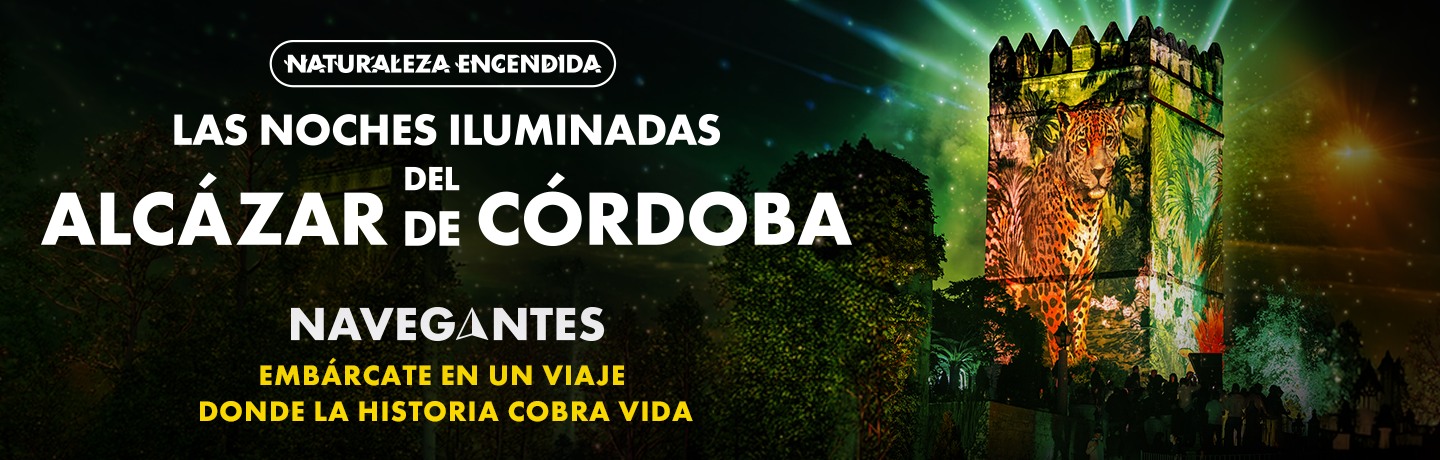

Naturaleza Encendida has returned to Córdoba: the history of the Alcázar becomes a nighttime experience.
Memory as a starting point
Building a story around a place can often feel difficult and unconvincing. But what happens when that same space already contains real events that changed the course of world history? The gardens of the Alcázar de los Reyes Cristianos are one of those places.
Its ponds, fountains and carefully arranged vegetation have shaped far more than a garden for centuries. Before becoming a contemplative space, the site was conceived as a setting for power and representation. And it was precisely here that one of the most decisive encounters in world history took place.
Since 1970, a sculpture by Pablo Yusti Conejo standing at the centre of the gardens has marked that moment: Christopher Columbus before Isabella and Ferdinand. The moment when the navigator presented his project to the monarchs opened the path toward a new perception of the world.
That is one of the key narrative ideas behind Navegantes: using a site whose historical memory functions not merely as context, but as an active part of the story itself. The experience is built upon a setting that already contains meaning.
World history inside a garden
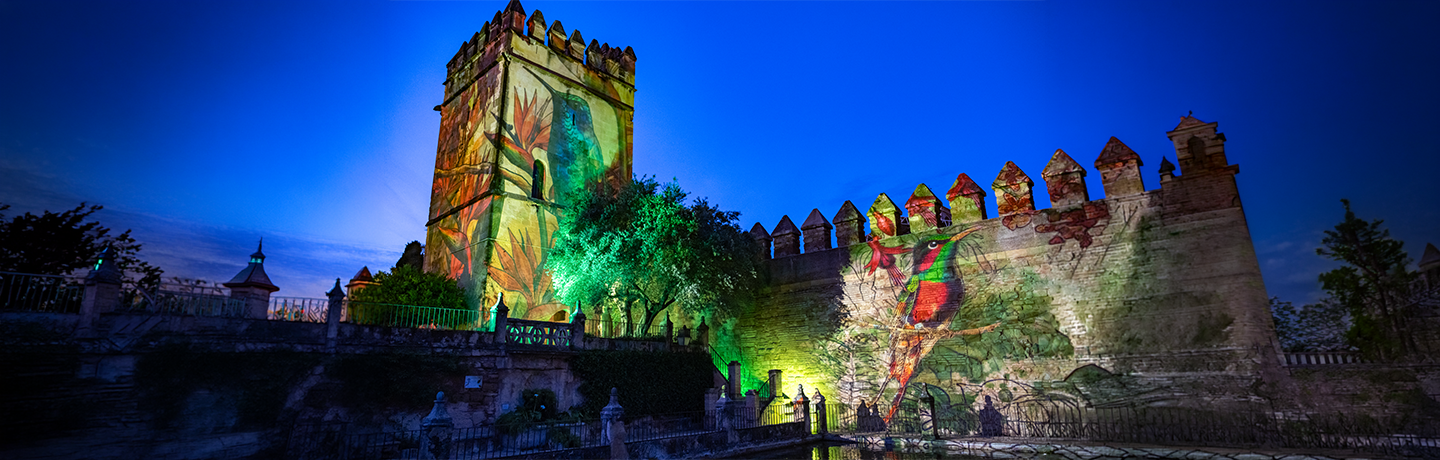
Built by Alfonso XI in 1328 over Roman, Visigothic and Caliphal structures, the Alcázar de los Reyes Cristianos condenses centuries of history into just a few hectares. It served as a regular residence for the Catholic Monarchs during the Granada campaign, while its gardens were designed as a visible representation of royal power. Córdoba’s historic centre, of which the Alcázar forms part, has been recognised as a UNESCO World Heritage Site since 1994.
But the garden does not function solely as a historical archive. It is also a botanical document. Olive trees, pomegranates and myrtle — direct traces of the Andalusian garden that existed before the Christian conquest — coexist with Atlas cedars, Mediterranean cypresses and date palms that shaped the Renaissance landscape Columbus himself may have known. Each plant adds another layer of time.
By day, the Alcázar is already one of Córdoba’s essential landmarks. By night, until now, it had remained closed.
Night as a narrative device
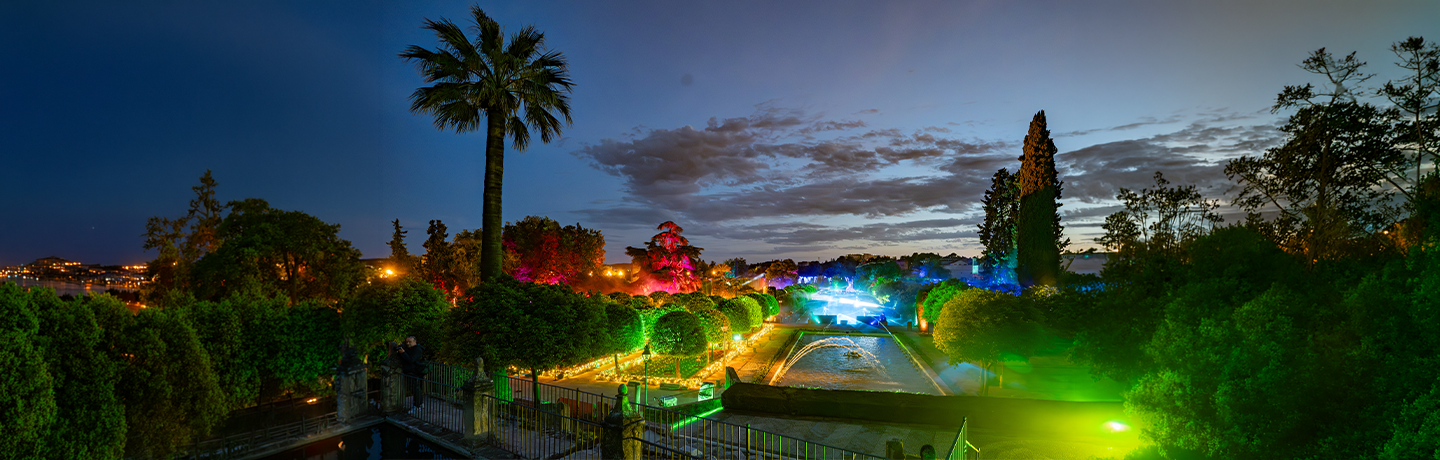
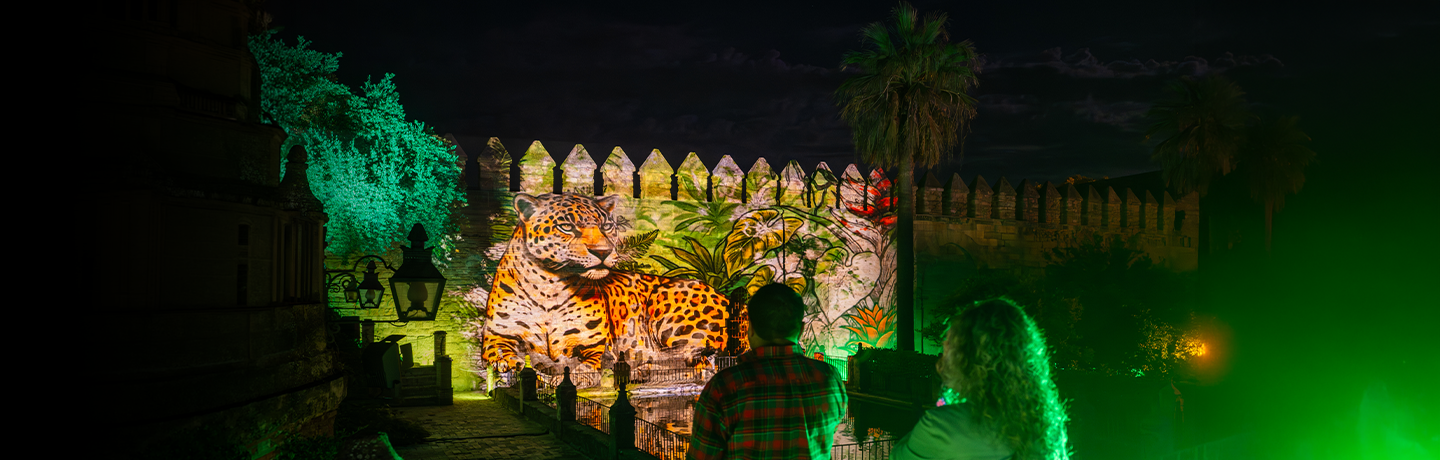
Naturaleza Encendida: Navegantes opens the gardens at night with a premise few immersive experiences can claim: the show takes place exactly where the events it tells once happened. Rather than recreating history inside a neutral setting, the project activates the memory of a place that already carried that story within it.
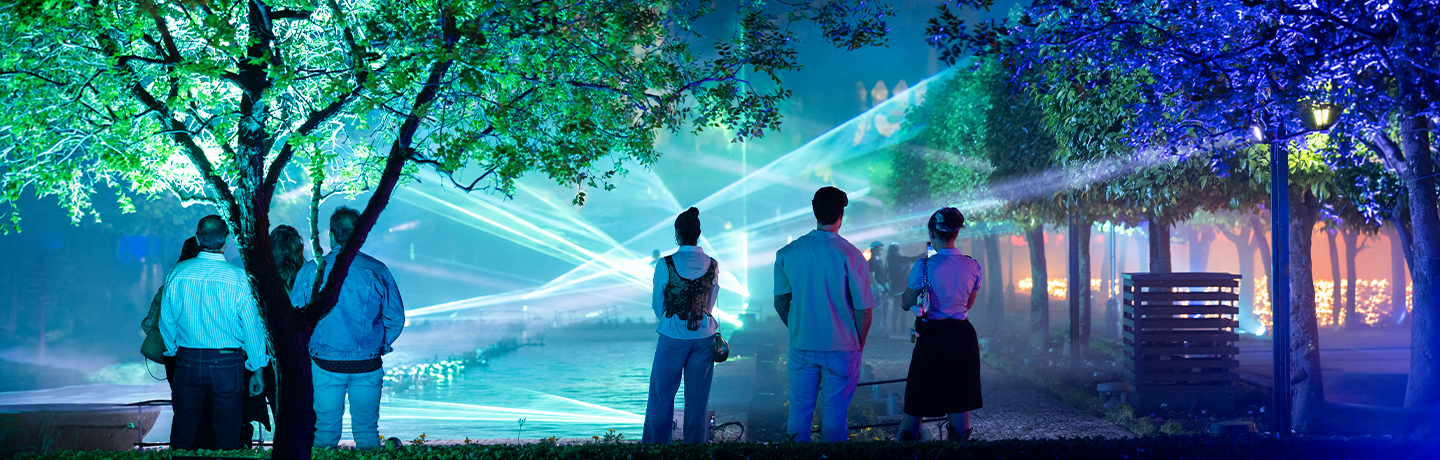
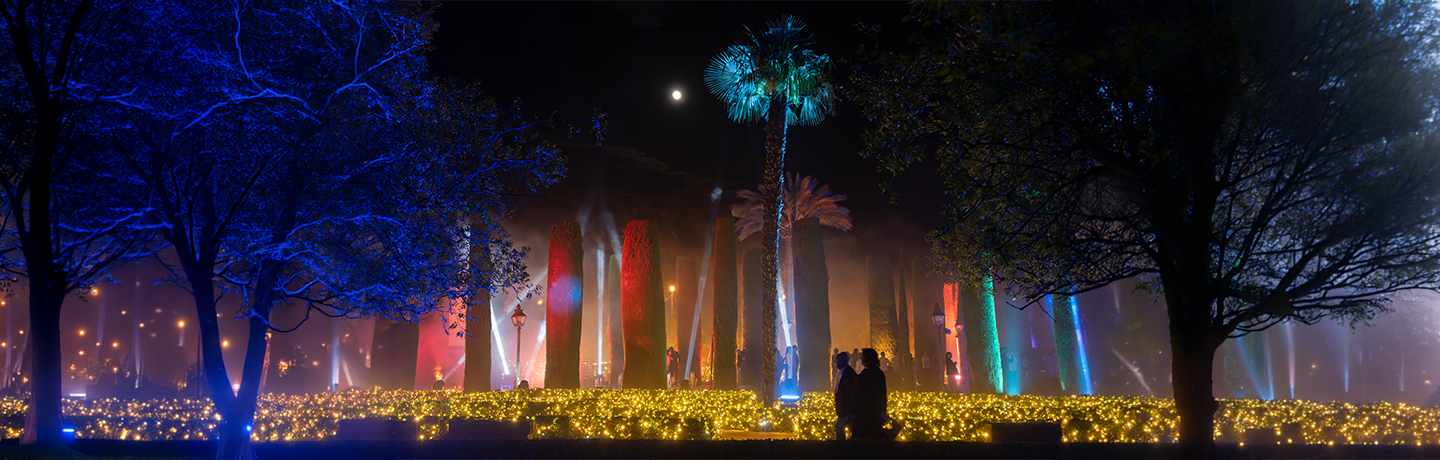
The route — 14 installations across approximately 45 minutes — is divided into three sections following the chronology of Columbus’ project: the meeting with the Catholic Monarchs inside the Alcázar itself, the 36-day Atlantic crossing, and the landing of October 12th, 1492. Video projection, intelligent LED systems and lasers transform ponds, trees and fountains into landscapes for each stage of the journey.
The second section, dedicated to the voyage itself, is the most physical. Visitors move through it as though they were part of the crew, crossing installations that recreate wind, waves and the disorientation of weeks at sea without sight of land.
Sound is what ties everything together. The original score is built around the evolution of flamenco guitar from its predecessor, the vihuela — the string instrument that dominated Renaissance courts during Columbus’ time. The choice is far from arbitrary: some sailors may well have carried vihuelas during the expedition, while Columbus himself likely encountered its sound at court.
The music evolves alongside the narrative. The vihuela of the opening section gradually gives way to the baroque guitar during the voyage, before flamenco guitar takes over at the moment of arrival. A sonic arc that embodies a story of cultural transformation.
The evolution of an immersive format
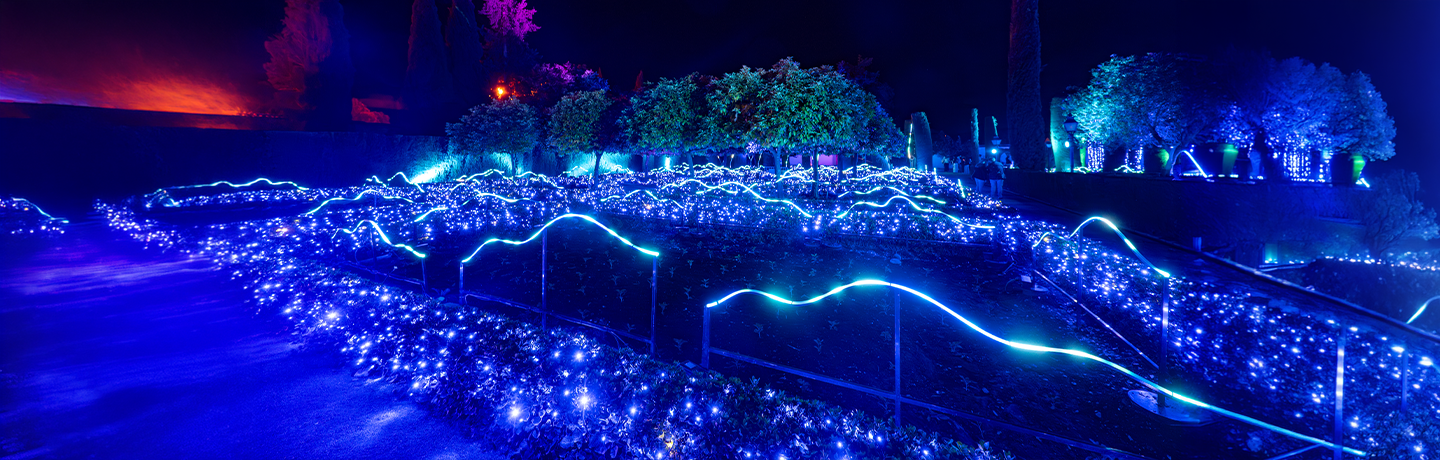
Navegantes arrives in Córdoba backed by a format that has already proven successful across Andalusia, and with a larger technical production than its predecessor: 750 elements compared to the 602 used in Raíces, alongside integration improvements specifically designed to minimise impact on the historic garden’s subsoil.
Intervening within a protected cultural heritage site comes with its own demands. As a result, the installation relates to the space in a particularly careful way: trees illuminated from within, projections reflected on water, and technology working in service of the environment rather than the other way around. The balance between intervention and respect ultimately defines the true meaning of the project.
May in Córdoba was already the month of the Patios Festival, the Cruces de Mayo and the Feria. Now, it also marks the nighttime opening of the city’s most historic garden.
By the LETSGO Pen, Claudia Pérez Carbonell, on May 14th, 2026.