
As the end of the season approaches, we examine how Houdini turned spectacle, press coverage and image-making into a system of fame long before the digital age.
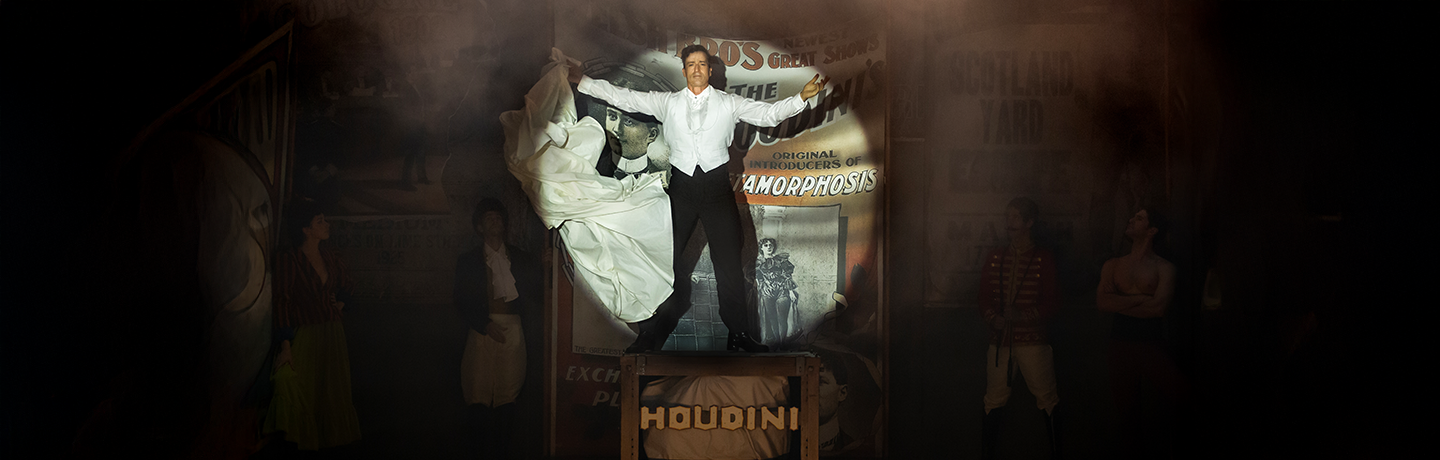
Production: Houdini: A Magical Musical (2025–2026). Photo: LETSGO.
From the early twentieth century onwards, a defining logic of contemporary culture was beginning to take shape: it is not enough to be good at something. You also have to make the world talk about it. Harry Houdini recognised, earlier than most, the first signs of that modern obsession with publicity.
His figure is usually reduced to familiar terms: escapology, illusion, risk, spectacle. Yet that reading can feel incomplete when one considers that he not only transformed a stage discipline; he also anticipated some of the mechanisms that now define modern celebrity, mass communication and personal brand-building.
His career offers more than the story of a famous magician. It reveals an early —and surprisingly sophisticated— form of cultural marketing.
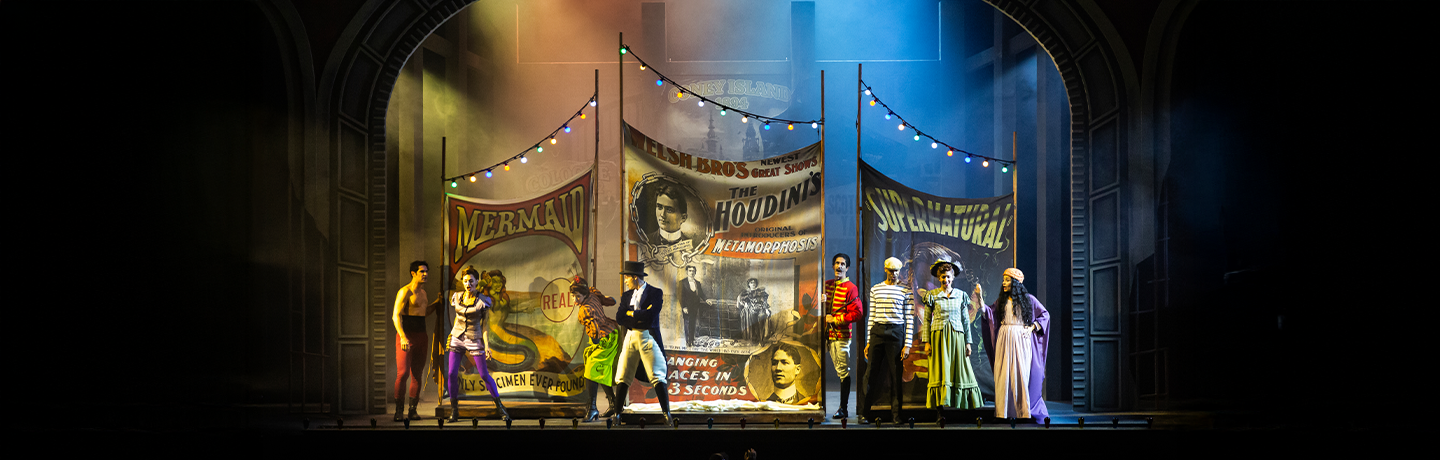
Production: Houdini: A Magical Musical (2025–2026). Photo: LETSGO.
Becoming a Name
Born Ehrich Weiss, the son of Hungarian Jewish immigrants in the United States, the man who would become Houdini understood very early something we now associate with personal branding: identity is also constructed.
The name change was far from anecdotal. It was an act of public positioning: short, striking, memorable, and carrying European resonances that suggested mystery and prestige. Houdini already sensed that talent needs a recognisable signature.
In contemporary terms, he understood a basic rule: before you position a product, you position a name. He would not be the last performer to do so, but he was among the first to exploit that logic with real consistency.

Production: Houdini: A Magical Musical (2025–2026). Photo: LETSGO.
Visual Construction: Posters and Image Control
Houdini’s visual dimension cannot be understood as a secondary element of his career, but as a central part of his visibility strategy. In the context of the late nineteenth and early twentieth centuries, theatrical and circus posters functioned as one of the main systems of mass communication: a hybrid medium combining advertising, illustration and visual storytelling, with far greater urban reach than the printed press among certain audiences.
Within that ecosystem, Houdini showed unusual attention to the coherence of his public representation. There is no evidence that he worked as a designer in the strict sense, but he was consistently involved in shaping how he should be perceived: which attributes had to be emphasised (physical strength, control, endurance, mastery over danger) and which image had to be repeated until it became instantly recognisable.
His posters tended to consolidate a stable visual repertoire: bodies under tension, devices of confinement (boxes, chains, cages, padlocks), and compositions that stressed the immediacy of danger. This repetition was not accidental aesthetics, but functional strategy: it created a visual grammar of “escape” that could be recognised even before seeing the performance itself.
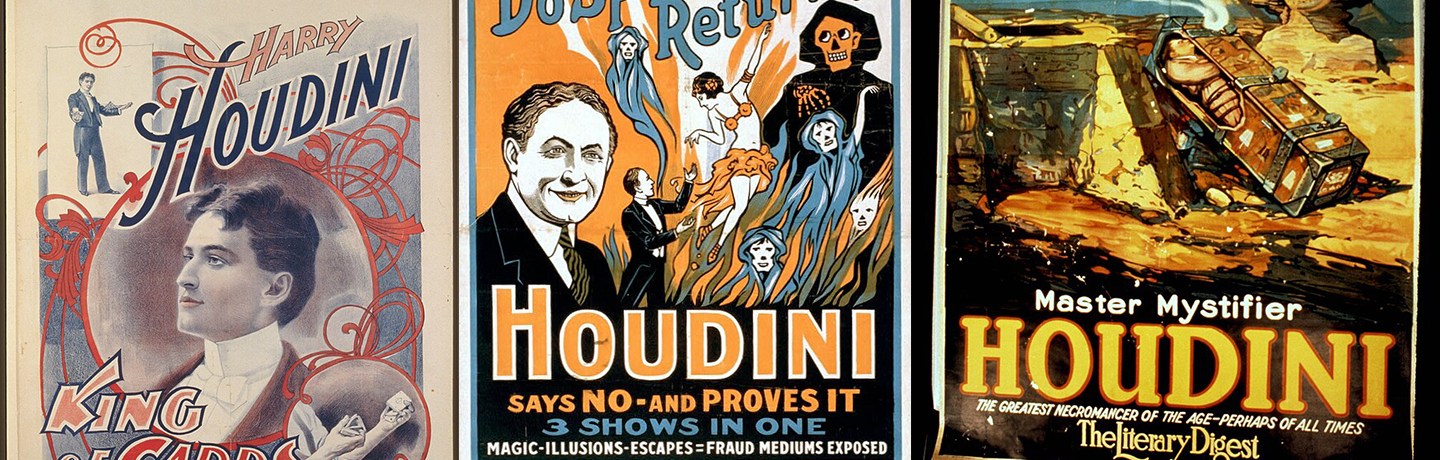
Collage of promotional images of Harry Houdini from the late nineteenth and early twentieth centuries, including King of Cards (1895), Houdini as Ghostbuster and Master Mystifier. Historical archive.
The Show Beyond the Stage
One of the greatest strengths of his career was moving promotional action into the public sphere. His escapes in police stations, prisons, streets or open spaces did not function merely as technical demonstrations. They were media events.
This logic is not a contemporary reinterpretation of the man. Even during his lifetime, his media dimension was obvious. An article published by The New York Times in 1918 described Houdini as “one of the greatest showmen of modern times,” highlighting not only his technical skill but also his ability to generate disbelief even among contemporaries and professional peers.
Beyond the praise itself, the article is revealing for what it suggests: Houdini’s fame was not perceived solely as the result of talent, but as the product of a constant accumulation of public gestures, challenges and demonstrations designed to be seen, discussed and remembered. In other words, his notoriety did not depend on the stage alone, but on its extension beyond it.
Daniel J. Boorstin later described in The Image (1962) “pseudo-events” as occurrences created primarily to be reported and circulated —a press conference, for example. The category applies strikingly well to many of Houdini’s actions: real events, certainly, but also designed to generate coverage, conversation and reputation.
Rather than waiting for newspapers to write about him, he handed them a story ready for publication.
In an era before television and long before the internet, he understood that visibility was not a consequence of artistic success, but part of its very structure.

Harry Houdini jumping from Harvard Bridge, Boston, Massachusetts. Image by John H. Thurston, stereopticons, 1852.
Repetition, Consistency and Brand
Biographies of the illusionist repeatedly identify one constant trait: his discipline in controlling every aspect of his public image. Nothing seemed left to chance. The poster, the pose, the narrative of risk, the international scale of his tours, the story of the man capable of surviving any confinement. Everything reinforced the same promise: with Houdini, the impossible was about to happen.
In contemporary terms, that is a strong brand.
Modern branding theory insists on one basic principle: strong brands are built through clear and repeated associations.
His name always pointed to the same symbolic territory:
- risk
- confinement
- challenge
- liberation
- the impossible overcome
That consistency explains much of his endurance. Audiences knew what to expect, but never how it would happen. And within that tension between familiarity and surprise lies one of the keys to any effective brand.
Attention as a Scarce Resource
He also understood something that now seems obvious: public attention is limited and competitive. To capture it, being present is not enough; one must stand apart.
While other magicians performed in theatres, Houdini turned the city into his stage, publicly issuing challenges and directly questioning the abilities of rivals.
The Value of Conflict
Another strikingly modern trait was his ability to generate narrative antagonism. His campaigns against fraudulent mediums and spiritualists placed him within a dispute easily understood by public opinion: truth versus deception, technique versus fraud, evidence versus superstition.
Conflict generated coverage. Coverage reinforced notoriety. Notoriety expanded the market.
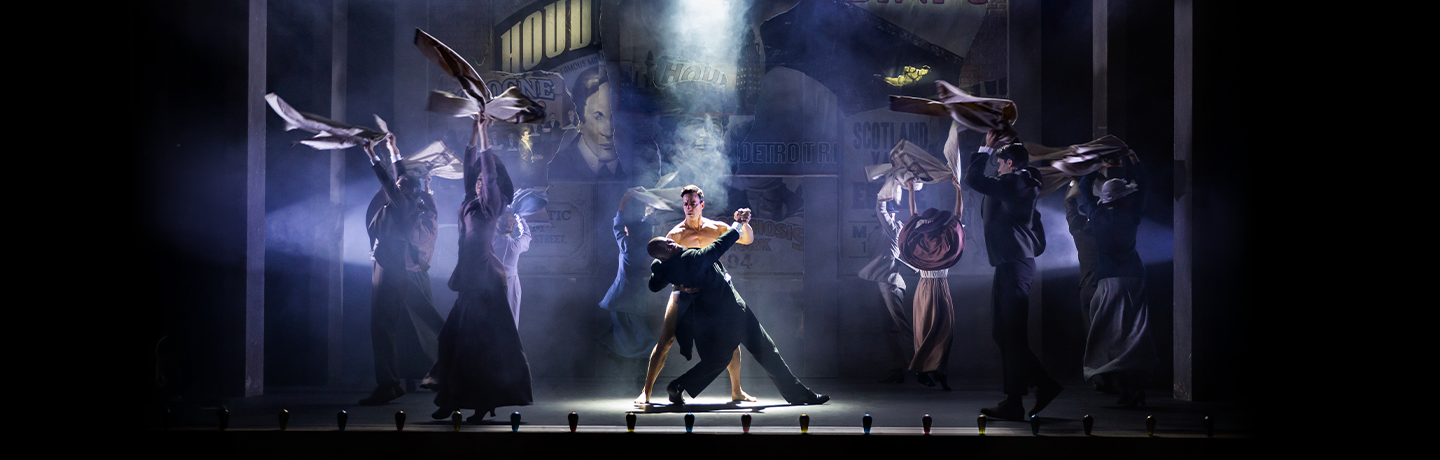
Production: Houdini: A Magical Musical (2025–2026). Photo: LETSGO.
Why He Still Feels Current
More than a century later, Houdini remains recognisable because he operated through logics that still endure: a deliberately constructed public identity, a coherent narrative sustained over time, events designed to circulate beyond the stage, and an early understanding of attention as a scarce resource.
What has changed are the platforms —today digital networks; then newspapers, posters and travelling shows— but not the underlying structure: the need to turn an action into an event, and an event into a story.
That is why reducing Houdini to a great escapologist is insufficient. He was also a brilliant operator of the public sphere, a strategist of visibility, and one of the first performers to understand that fame, before it is achieved, must also be designed.
By the LETSGO Pen, Claudia Pérez Carbonell, on April 24th, 2026