
The role of sound in the emotional, sensory, and narrative construction of immersive experiences.
From digital passivity to immersive engagement
We live surrounded by stimuli. Screens have redefined our relationship with attention. Every digital interaction —a scroll, a click, a notification— triggers small bursts of reward that fragment experience into increasingly shorter units. We consume more than ever, yet in an increasingly passive way.
This overload of stimulation and perceptual fatigue has, almost inevitably, led to the emergence of new forms of experience that operate in the opposite direction. Against the logic of passive observation, certain artistic and entertainment practices have begun to explore more active models that demand presence, involvement, and response.
The rise of immersive and interactive experiences responds, in part, to this latent need: to reactivate senses that have grown numb within everyday routines. It is no longer enough to watch. We seek to enter, to move through, to decide, to take part. Not simply to witness a story, but to inhabit it —and, to some extent, to have the power and opportunity to influence it.
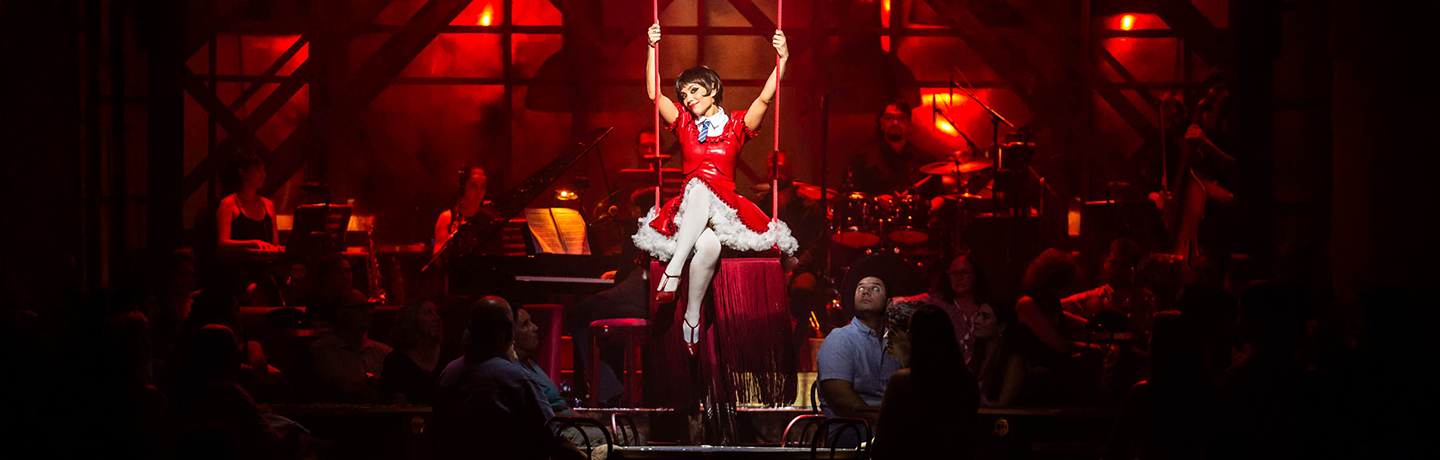
Production: Cabaret. Photo: LETSGO.
Inhabiting the story: narrative as sensory experience
Immersive storytelling, therefore, does not simply tell stories —it turns them into inhabitable spaces. It functions as a mechanism of transition, one that transports the spectator into other contexts —another time, another place, another emotional logic— through a precise combination of scenographic, technological, and sensory tools.
In these kinds of experiences, the narrative is no longer something to be observed, but something to be traversed. And within that shift, music, space, light, and the body do not merely accompany the story; they actively —and fundamentally— construct it.
This is no coincidence. As Margaret Kerrison (2022) notes:
We’re in the business of emotion: and to get to the heart, a good narrative has to come from the heart.
Emotion is not a byproduct of storytelling, it is its raw material. It is, in a way, the clay shaped on the wheel of human experience. But that experience does not occur in abstraction: it is mediated through the body. We perceive the world —and, therefore, stories— through a sensory system that translates stimuli into meaning. Touch, sound, image, smell, even the texture of space itself activate responses that shape how we interpret what unfolds.
The question, then, is not only what is being told, but what happens when a narrative physically passes through us, subtly altering our perception of reality. It is there that emotion can truly be experienced —sometimes even consciously.
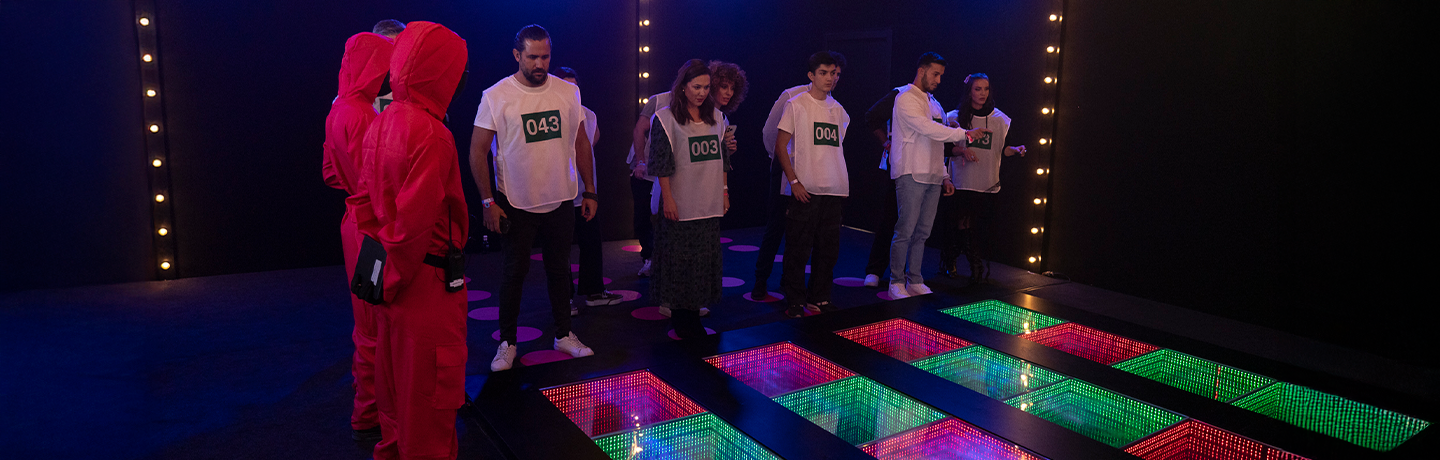
Production: Squid Game: The Experience. Photo: LETSGO.
The logic of sensory storytelling
At this point, it is important to draw a fundamental distinction: story —the chronological sequence of events— is not the same as narrative, understood as the system of decisions that determines how that story is perceived, felt, and experienced. In immersive contexts, this distinction becomes essential.
What defines these experiences is the shift from a traditional narrative language to a primary emotional language, where understanding is not only intellectual, but physical and sensory. This is where what we might call sensory storytelling emerges: a mode of narrative construction that operates through stimuli, atmospheres, and rhythms rather than explanations. In this context, there is a multiplicity of stimuli, stories, and ways of both telling and receiving them.
The most compelling examples of immersive storytelling, regardless of format or scale, tend to share a number of common characteristics (Kerrison, 2022):
- The centrality of emotion as the narrative driver
- The coordinated activation of multiple senses
- The credible construction of a distinct time and space
- An explicit invitation to participation and play
- The encouragement of social interaction as part of the experience
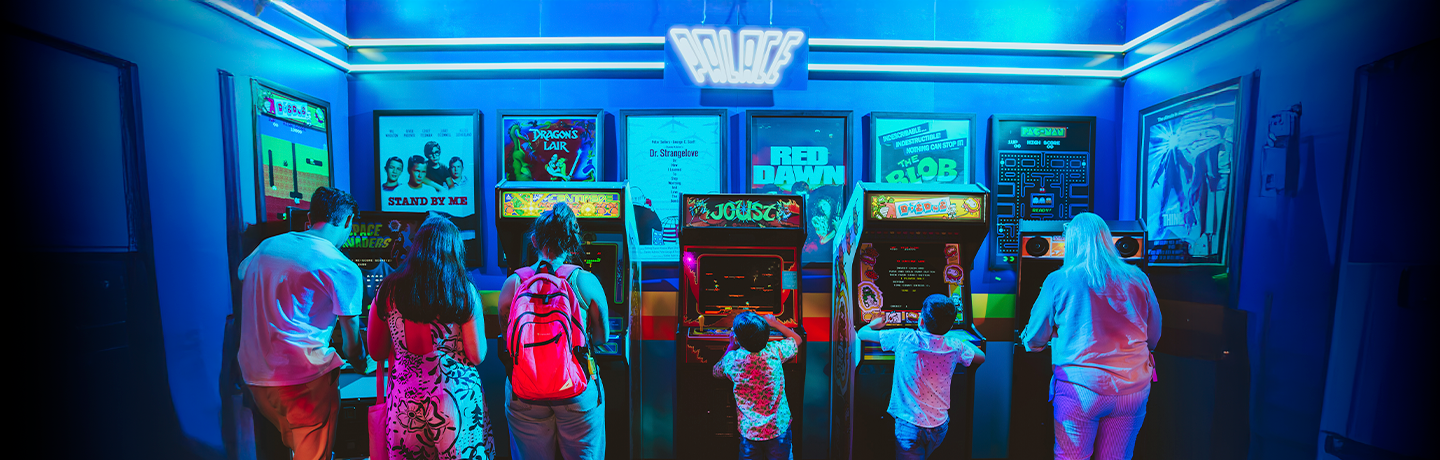
Production: Stranger Things: The Experience. Photo: LETSGO.
Immersive sound as a legacy of installation art
At this point, music —one of the key architects of the worlds created within immersive experiences— begins to take on qualities that align it more closely with the codes of contemporary art. For decades, artists such as Brian Eno, Janet Cardiff, and Olafur Eliasson have explored sound as a means of constructing space, altering perception, and choreographing the spectator’s experience.
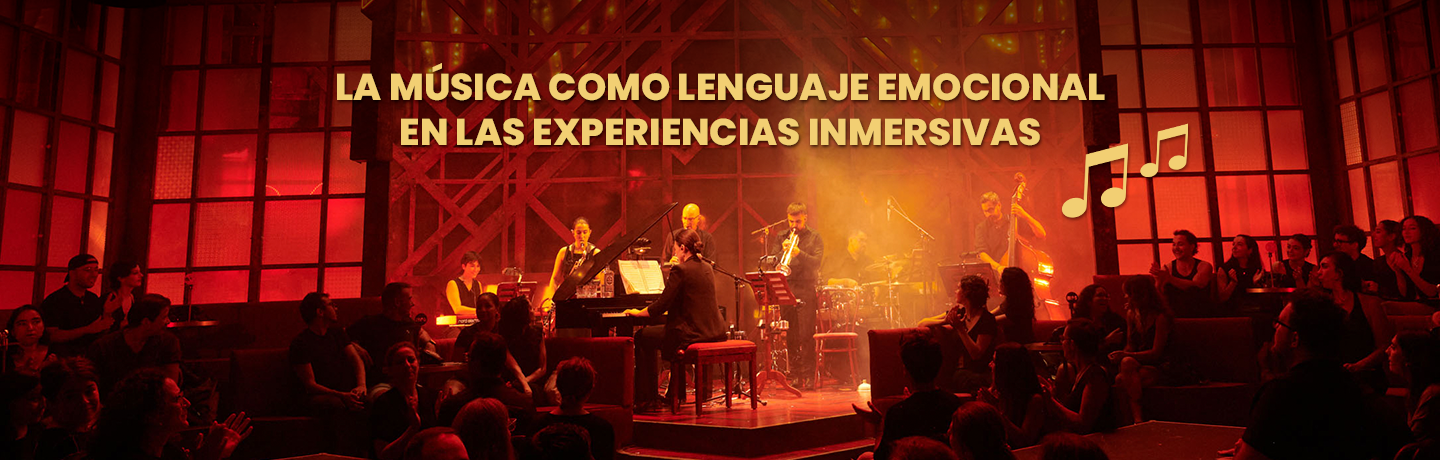
What matters here is not the aesthetic analogy, but the shared logic: sound as environment. Rather than underscoring action, music defines a state —an atmosphere— capable of modulating the internal sense of time of those who move through it.
From this perspective, many contemporary immersive experiences are not inventing a new language, but rather translating —through different tools and scales— principles that installation art has been exploring for decades.
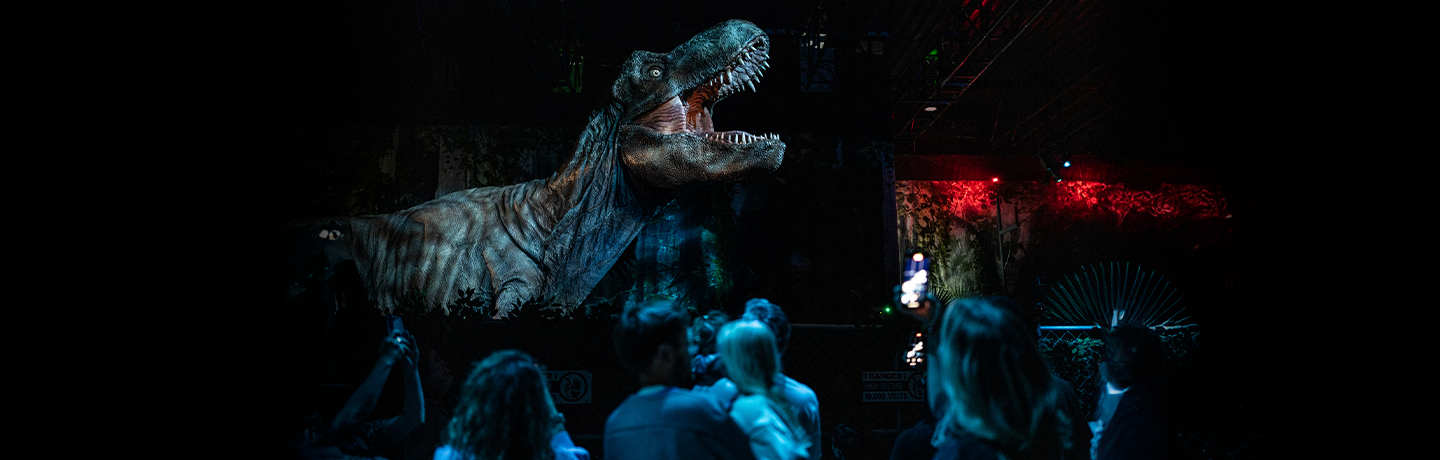
Production: Jurassic World: The Experience. Photo: LETSGO.
Music as invisible architecture: contemporary immersive experiences
When this logic is applied to contemporary immersive experiences, music ceases to function as a supporting element and becomes a structural one.
In productions such as Cabaret —one of the most singular cases— music takes on a particularly decisive role. It is during moments like the preshow that its function becomes most evident: rather than simply setting the mood, it gradually absorbs the spectator into the scenic universe. Musicians and performers move through the space, sing, approach, interact; sound does not remain fixed, but circulates, envelops, and redirects attention.
In this way, a sustained atmosphere is constructed —one that is not perceived as artifice, but as a temporary reality: the illusion of having a drink in a Berlin club during the interwar period. Within this context, music plays an active role in legitimising the experience; it is the mechanism that shifts the spectator from observation to involvement, integrating them —almost imperceptibly— into the dramatic system.
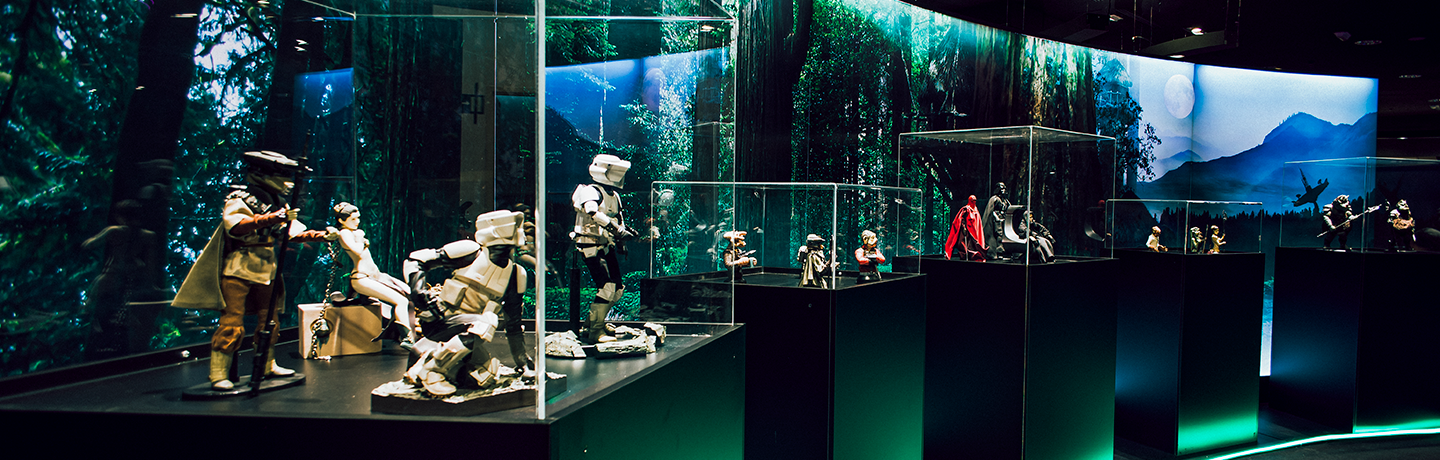
Production: El Imperio Fan Contraataca (próximo estreno el 6 de mayo en Espacio Delicias). Photo: LETSGO.
In experiences such as Jurassic World: The Experience, the use of a recognisable sonic universe introduces an additional layer of meaning. Music does not merely generate tension or spectacle; it activates a prior memory in the spectator, connecting the physical experience with an already internalised narrative world. The result is an amplified perception, where what is lived merges with what is remembered.
In the case of Squid Game: The Experience, music and sound design operate according to a different, yet equally precise logic. Rather than creating a traditionally immersive atmosphere, sound introduces a constant tension through recognisable contrasts: seemingly innocent melodies coexist with dynamics of play and danger. This sonic friction not only references the original universe, but directly conditions the spectator’s response, triggering an almost physical sense of alertness. Here, music does not seek to integrate, but to destabilise —reminding us that the experience is not only playful, but also competitive and vulnerable.
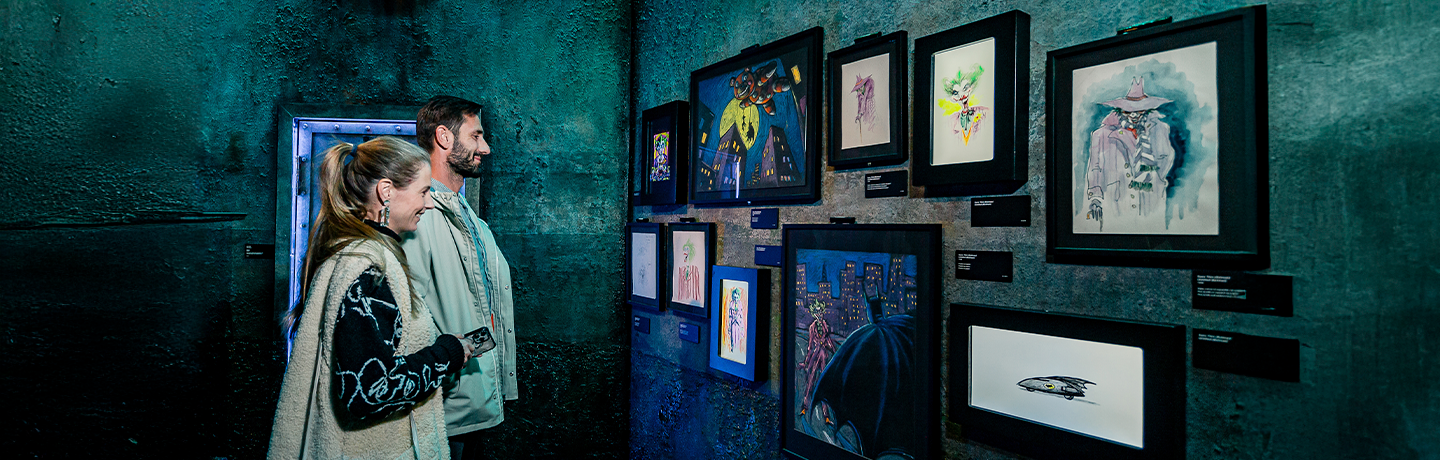
Production: Tim Burton’s Labyrinth. Photo: LETSGO.
In Tim Burton’s Labyrinth, sound design is articulated around the very structure of the experience: a labyrinthine journey in which the spectator chooses their own path. Each room, built around different films and characters, unfolds a distinct sonic identity that not only sets the atmosphere, but also guides and differentiates spaces.
Here, music is crucial —not only for its immersive function, but because it is embedded in the DNA of Burton’s universe itself. The compositions of Danny Elfman, with their blend of strangeness, lyricism, and darkness, complete the identity of each image. Translated into the exhibition space, they operate as a cohesive system that allows the spectator to perceive a recognisable and coherent world, despite the fragmented nature of the journey.
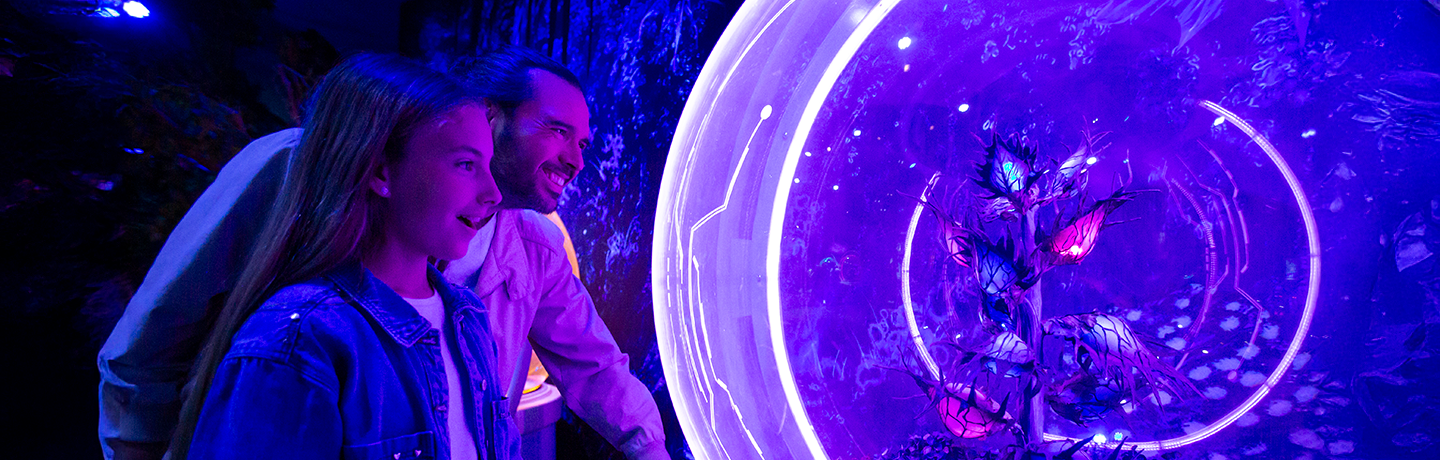
Production: Avatar: The Experience. Photo: LETSGO.
In experiences such as Navegantes, immersion is built upon a clearly articulated internal narrative in which light, music, and technology operate in unison. The show transforms the gardens of the Alcázar de los Reyes Cristianos into a scenographic environment that evokes the first meeting between Christopher Columbus and the Catholic Monarchs —an encounter that marked the beginning of an expedition that would change the course of history.
In this context, music does not merely accompany the visual transformation of the environment; it provides emotional continuity to a historical moment fragmented into images, reinforcing the sensation of travelling into another time.
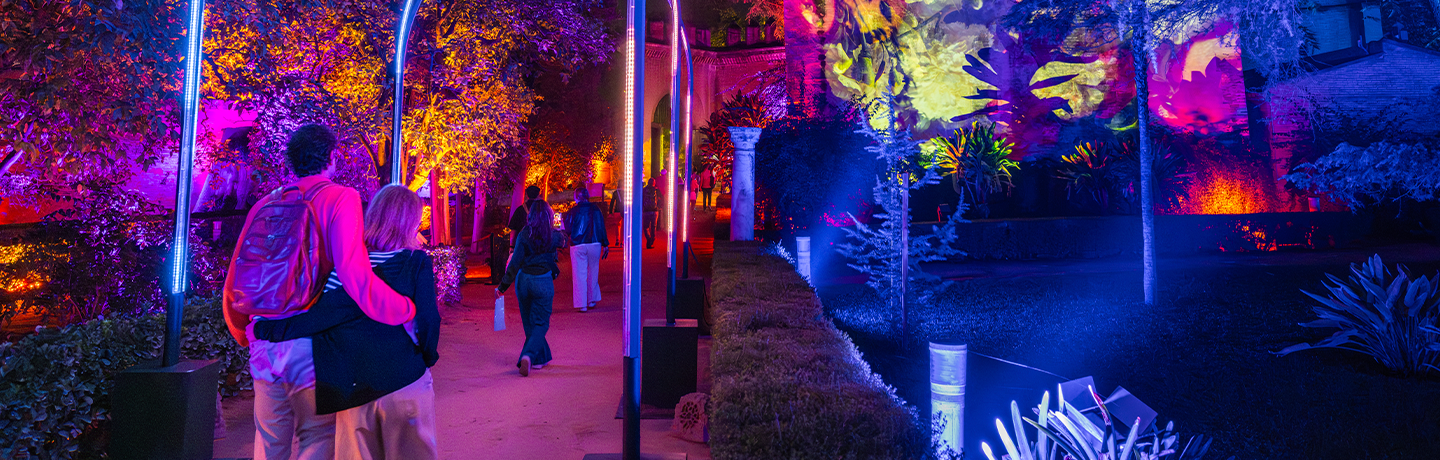
Production: Naturaleza Encendida. Photo: LETSGO.
In all these examples, music shares a fundamental function: it is not necessarily perceived as the protagonist, yet it decisively shapes the experience. It is a language that operates beneath the surface, organising time, space, and emotion.
By the LETSGO Pen, Claudia Pérez Carbonell, on April 17th, 2026