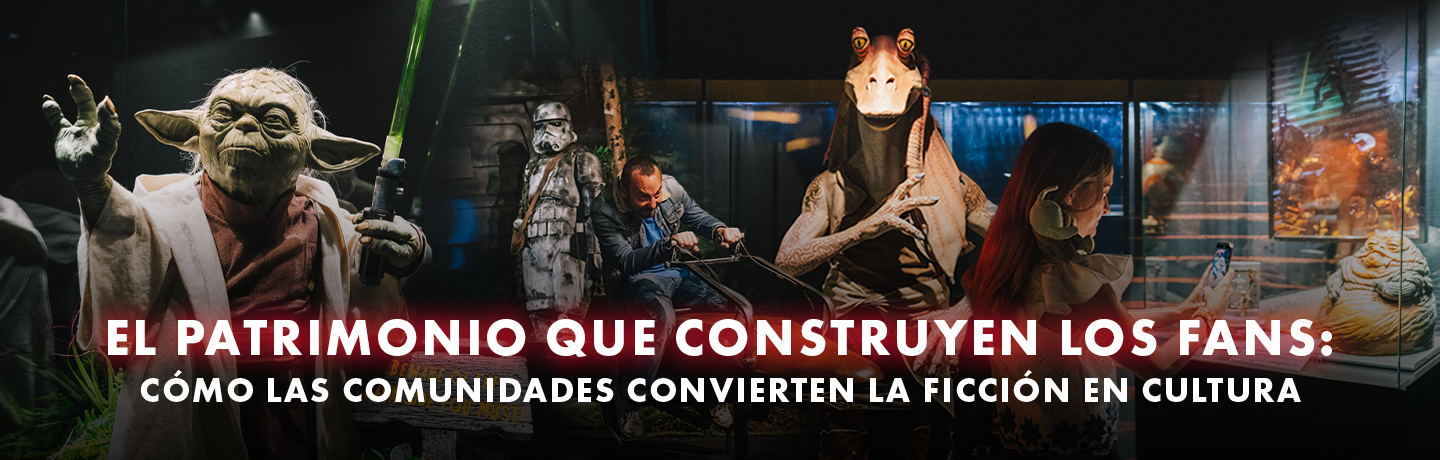

Collecting, restoring and passing stories on: fandom reproduces the mechanisms of cultural heritage without needing the validation of an institution.
From Museum Object to Fan Object
A medieval suit of armour, a Roman amphora or the manuscript of a literary classic never have to justify their place in a museum. They have endured the passage of time, and that alone makes them part of our shared history. But when the object on display is a stormtrooper helmet or an action figure carefully preserved for forty years, the question shifts. The focus is no longer on how long the object has survived, but on who decided it was worth preserving.
Rethinking the Meaning of Heritage
For centuries, cultural heritage was understood as a collection of exceptional material objects that deserved protection. Over time, however, that definition has evolved. Today we recognise that heritage also includes traditions, knowledge, practices and ways of understanding the world that survive because communities choose to keep them alive. It is no coincidence that UNESCO expanded the concept of heritage to include intangible cultural heritage: what a society considers worth passing on is also part of its cultural legacy.
The same logic invites us to look at today’s major fandoms in a different light.
A fandom is not simply a group of people who enjoy the same film, franchise or character. It is a community that develops its own language, creates rituals, shares knowledge and transforms fiction into a collective experience. Its members reinterpret stories, expand them and keep them alive long after the media spotlight has faded.
The Fan as a Producer of Meaning
It was this very idea that began to reshape the study of popular culture in the early 1990s. Media scholar Henry Jenkins (1992) challenged the stereotype of the fan as an obsessive consumer, describing fans instead as active participants capable of generating new meanings. In Textual Poachers, he argued that fans “poach” the texts they love, creatively making them their own: they write new stories, design costumes, organise events, produce videos, develop theories and generate a collective body of knowledge that no production company could ever orchestrate on its own.
Later, in Convergence Culture, Jenkins explained how the relationship between creators and audiences had ceased to be one-way. Fan communities became spaces where information is exchanged, ideas are debated, collective memory is preserved and, in many cases, the future of the franchises themselves is influenced.
Identity Built Through Fiction
But the phenomenon extends far beyond digital participation.
Sociologist Matt Hills argues that fandoms are spaces where identities are constructed. We do not simply choose the stories we enjoy; we also use those stories to explain who we are. That is why the objects associated with a franchise eventually stop being commercial products. They become memories, personal symbols and, over time, witnesses to experiences shared across generations.
Seen from this perspective, fandoms function as genuine heritage communities.
They collect. They catalogue. They restore. They document. They recreate costumes. They organise conventions. They digitise out-of-print material. They preserve objects that might otherwise disappear. They pass on their knowledge to new generations of fans and keep fictional worlds alive for decades.
Star Wars: Nearly Five Decades of Community-Led Preservation
Few franchises illustrate this phenomenon better than Star Wars.
Since its debut in 1977, the saga has transcended cinema to become a shared cultural language across generations. Parents and children recognise the same characters. Collectors have spent decades preserving toys, posters, models and production memorabilia. Thousands of people dedicate countless hours to building replicas, refining costumes and documenting every detail of a fictional universe with almost archival precision.
The enduring strength of Star Wars does not lie solely in the films themselves. It lies in the people who have decided that this story deserves to keep being told.
The Fans Strike Back as a Living Archive
This is the idea at the heart of The Fans Strike Back. Rather than a collection of objects related to an influential franchise, the exhibition can be understood as the material record of a community that has spent decades preserving its own universe. Every object on display tells two stories: that of the original fiction, and that of the people who chose to safeguard it.
The figures, replicas, costumes, illustrations, scale models and vintage editions do more than chronicle the history of Star Wars. They also tell the story of the collectors who searched for them, cared for them and gave them a value that goes far beyond collecting for collecting’s sake.
Each object represents countless hours of dedication, research and, in many cases, a conscious determination to ensure that a piece of popular culture would not be lost. They are tangible proof that fans do far more than consume the stories they love: they document them, restore them, contextualise them and pass them on to future generations.
The heritage of our time is no longer defined solely by the age of the objects we preserve. It is also defined by the communities that give those objects meaning. For centuries we have protected castles, manuscripts and paintings because they represented part of our collective memory. Today, we are beginning to recognise that the stories that have shaped millions of lives deserve to be viewed through the very same lens.
By the LETSGO Pen, Claudia Pérez Carbonell, on July 13th, 2026