
How A$AP Rocky turns Tim Burton’s aesthetic into an urban, provocative and contemporary language.
The time has definitively come to dismantle the stigmas surrounding rap and look beyond its clichés. With Don’t Be Dumb, A$AP Rocky does not simply return: he unfolds a complex universe of meanings that challenges every expectation surrounding his long-awaited album. The collaboration with Tim Burton, alongside the involvement of Winona Ryder and Danny Elfman, elevates his music and places it at a natural point of evolution within his career. The project becomes a visual and sonic manifesto in which urban expressionism, fragmented identity and abstract surveillance converge through a logic that feels unexpectedly organic.
At first glance, the collaboration seems like a clash of worlds: the Harlem rapper and the quintessential contemporary gothic filmmaker. Yet if both artists work in — and from — the cultural margins of society, is the collaboration really that strange? Once the initial shock fades, a clear throughline emerges across the project: an urban and futuristic expressionism — as Rocky understands it — where the chaos of the city and the fragmentation of the self operate according to the same internal logic that has defined both universes for decades.
The origin of what they share
Rocky does not see Burton merely as an eccentric filmmaker, but as the contemporary embodiment of German Expressionism: distorted worlds, amplified emotions, and the city and its institutions as projections of mental states. From a young age, this aesthetic fascinated Rocky; today, with Don’t Be Dumb, he brings it into a more explicitly urban present, constructing a form of “ghetto expressionism” — a futurism that breathes chaos — where alter egos, helicopters and forces of urban control function as symbols of surveillance, pressure and resistance.
Burton’s visual language in Don’t Be Dumb
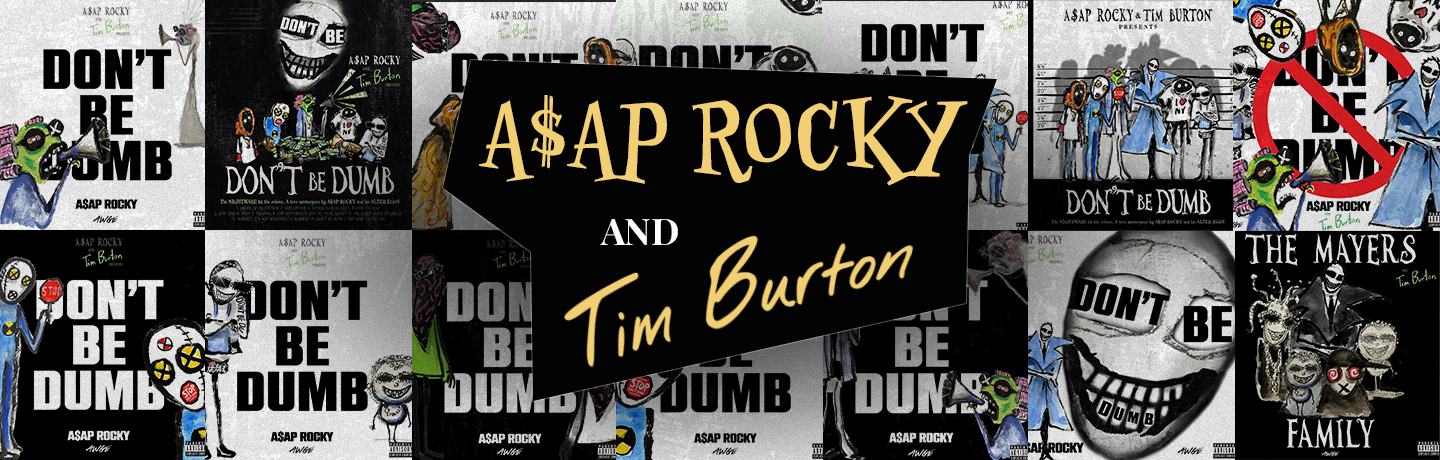
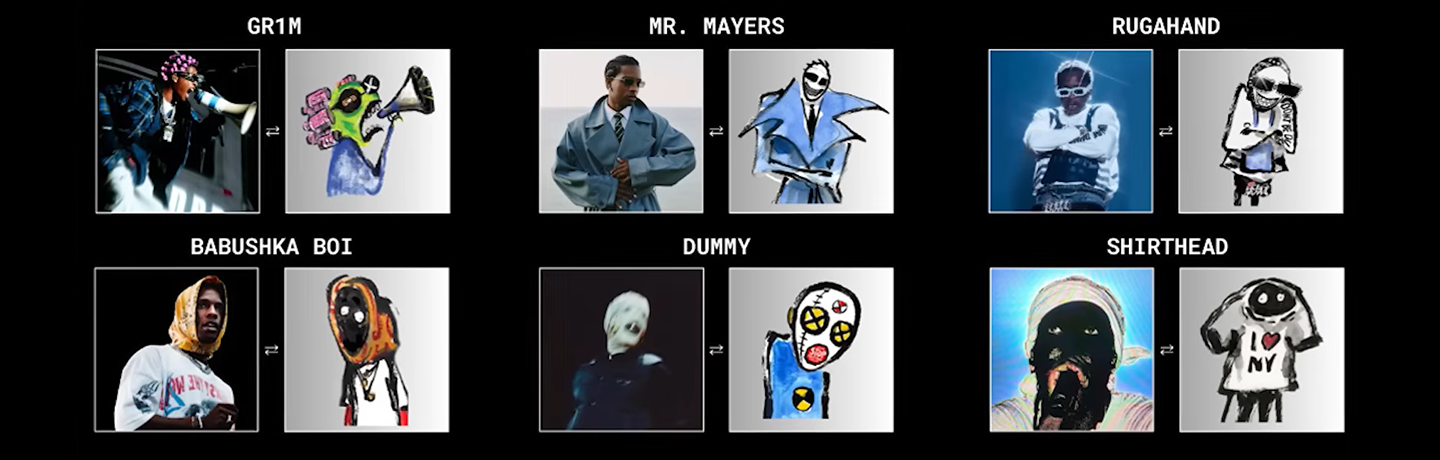
Don’t Be Dumb arrives accompanied by images, characters and episodes that extend its world beyond music. The album cover, designed by Burton, functions like an animated sketchbook. The figures embody fragments of identity: GR1M, MR. MAYERS, RUGAHAND, BABUSHKA BOI, DUMMY and SHIRTHEAD represent different facets of the rapper, reflecting his constant self-splitting — the fashion icon, the provocateur, the introspective artist — while simultaneously dialoguing with Burton’s visual sensibility. Burton does not invade or reinterpret Rocky; he translates him into his own visual language, amplifying what was already present in the rapper’s imagination.
This visual logic unfolds further in the videos, beginning with Whiskey / Black Demarco. The piece opens with a voice-over setting the night before the album’s release. Burton is introduced in a bar as “a man with a sketchbook… not ordinary by far,” before falling asleep as his sketches run loose across the city. His drawings generate chaos — from the bar to the subway, eventually engulfing all of New York City. When he wakes up and steps outside, he looks at a giant vinyl record: first he sees “C.O.R.P.” crossed out, a symbol of control and system; then, after removing his glasses, Don’t Be Dumb appears in its place, featuring Burton’s artwork. The visual gesture is not merely aesthetic, but conceptual: the work is born from its own internal logic.
Visual leitmotifs
With the videos for Punk Rocky and Helicopter$, the album’s universe expands further. Helicopters, police forces, alter egos and abstract symbols of authority recur as visual leitmotifs. Each clip functions as a fragment of the same system rather than as a linear narrative. Winona Ryder embodies the emotional memory of Burton’s universe, evoking the unsettling familiarity of his iconic protagonists; Danny Elfman, who has scored Burton’s films throughout his career, contributes experimental orchestral layers that intensify the atmosphere; and Rocky remains the stable thread, performing his multiple selves within a surveilled and fragmented environment. The repetition of these elements reinforces the sense of a cohesive world — the construction of a ghetto futurism that is absurd and coherent at once.
From legacy to risk: the sonic mutation of Don’t Be Dumb
Don’t Be Dumb operates within a conscious space of transition. The album begins with codes familiar in A$AP Rocky’s trajectory — precise flows, references to luxury, the iconic pose — but subjects them to a process of progressive deformation. As it unfolds, the record moves toward less obvious structures, fragmented beats and more tense atmospheres.
This shift from the familiar to the experimental functions as a sonic translation of the urban expressionism running through the project: form bends to express a mental state. Here, experimentation does not seek radical rupture, but friction. Initial recognition allows the subsequent estrangement to land with greater impact.
Rocky does not abandon his identity; he multiplies it. The result is not an album that distances itself from his legacy, but one that pushes it into more unstable, abstract territory — and precisely for that reason, into deeper coherence with the world Don’t Be Dumb constructs.
The album is sustained by a constellation of producers who reinforce and expand its sonic universe. Among the most prominent names are Pharrell Williams, Metro Boomin, Madlib, The Alchemist and Mike Dean, each bringing a distinctive imprint that ranges from classic groove to experimental and textural approaches, supporting Rocky’s transition from the recognizable toward more daring terrain.
Ver esta publicación en Instagram
The Crystallization of a Shared Imaginary
Don’t Be Dumb is not only A$AP Rocky’s return after years of silence, but the crystallization of a childhood obsession: expressionism — reimagined as an urban, ghetto-based, futuristic expressionism — where the collaboration with Tim Burton feels, at the very least, inevitable. Through the videos, Rocky constructs a confrontational, surveilled and fragmented universe in which strangeness is the base language.
Burton remains the master of contemporary gothic cinema, capable of building recognizable and obsessively coherent worlds; Rocky, meanwhile, stands as a Harlem rap icon with global influence across fashion, culture and urban sound. By joining forces, neither loses identity nor authority within their respective niches — instead, they amplify one another. The fusion of both universes creates a hybrid space where strangeness and coherence do not compete, but intensify each other, making Don’t Be Dumb a singular project that speaks simultaneously to rap audiences and followers of the Burtonian imaginary.
Ver esta publicación en Instagram
By the LETSGO Pen, Claudia Pérez Carbonell, on January 22nd, 2026