
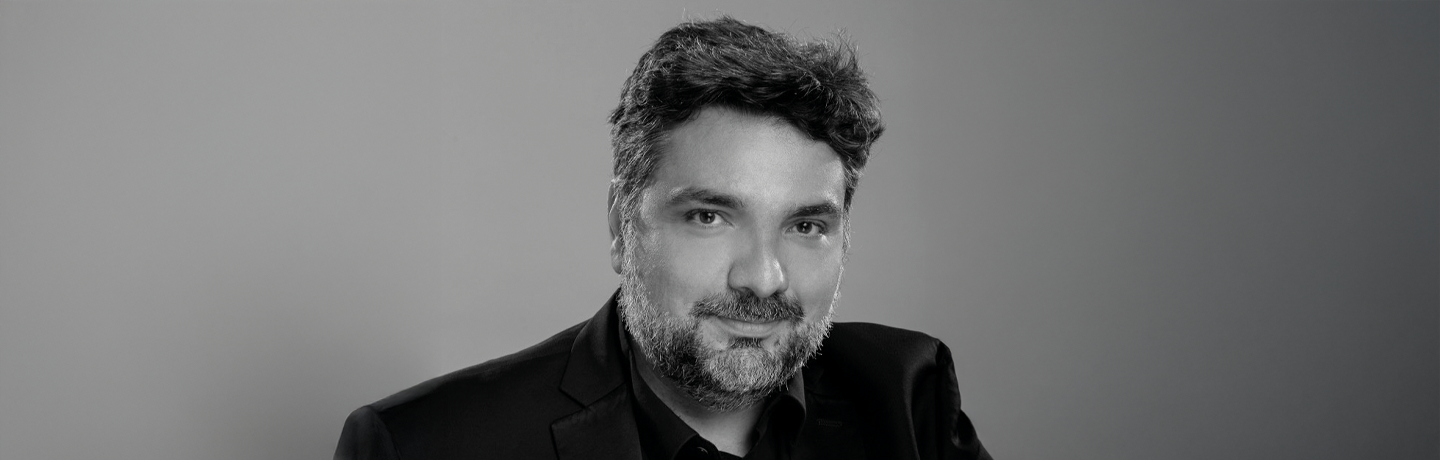
We spoke with Julio Awad about the craft of the musical director, the power of silence, and how lived experience shapes interpretation.
Music is like a poison that stings you and leaves you no alternative. Once it gets you, your life never leaves it.
Born in Buenos Aires and trained at the National Conservatory López Buchardo, Julio Awad began his professional career while still a teenager, composing for television and theatre. Since arriving in Spain in 2000, his trajectory has run parallel to the development of musical theatre in the country, serving as musical director for titles such as The Phantom of the Opera, Evita, Sunset Boulevard, Kinky Boots and Priscilla, Queen of the Desert, while also working in concerts and recordings with artists including Paloma San Basilio, Isabel Pantoja, Estrella Morente and Omara Portuondo. His activity also extends to audiovisual work and original composition, forming an unusual profile defined by continuity between stage, studio and live performance. Awarded the Talía Prize for The Phantom of the Opera and several industry recognitions, Awad has established himself as one of the leading figures in musical direction in Spain, with a sustained career combining genre specialization and stylistic versatility. He is currently preparing a new production of The Addams Family alongside LETSGO and beon.Entertainment.
The live performance: music and stage in dialogue
It’s Saturday, around 8:30 p.m. You arrive —as always— just in time, but before the curtain rises. Two and a half hours later you leave talking about the performances, the voices, how they can sing, dance and act with such apparent ease. If you linger a moment longer, you also remember how good the orchestra sounded.
But something else has happened during the performance: music and stage have been in real-time dialogue. Every gesture and every cue occurred exactly when it had to, even though nothing was exactly the same as the night before. And then a question appears that we almost never ask: who sustains that balance live, and how is something built every night that only exists once?
A musical never happens only onstage. The performance lasts as long as the coordination between two invisible spaces: stage and pit. That illusion of stability —that the music unfolds as if inevitable— is precisely the work of the musical director.
The musical director is the link between orchestra and cast. They decide and program how the show must be performed musically and, once the performance begins, they steer the ship. Much of the work happens beforehand: communicating to actors and musicians how to interpret the score.” —Julio Awad
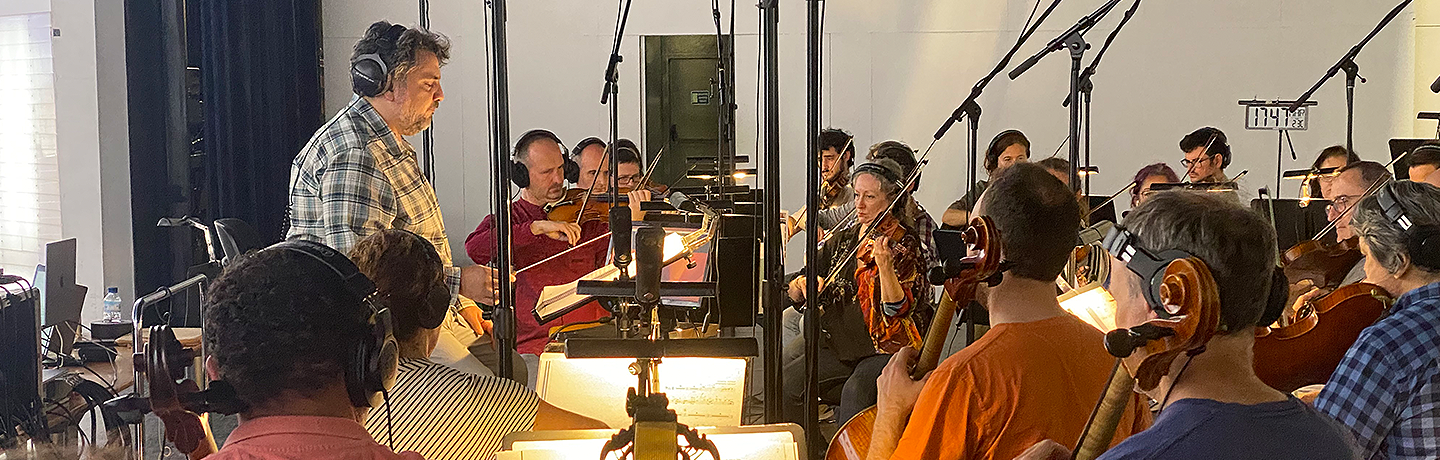
Julio Awad conducting the Extremadura Symphony Orchestra.
In the shadow of the spectacle: craft and recognition
For decades, musical theatre has been perceived mainly from the stage: voices, acting, visual spectacle. Yet its real functioning depends on a network of professions whose presence is essential precisely because it goes unnoticed.
Musical direction belongs to that category of “shadow work”: roles that do not seek to be seen but to sustain the coherence of everything else. For Awad, that is a comfortable place from which to operate.
In musical theatre we serve the actors and the audience. The musical director faces away; the actor faces forward and is the one who must be recognised. Our work is one piece of a huge puzzle —important, but just one more. As important as a stagehand or a concertmaster. And I think by now the audience knows what we do.
Understanding what a musical director actually does —or even pausing to identify that figure situated between pit and stage— becomes a first step toward a fuller perception of the genre itself.
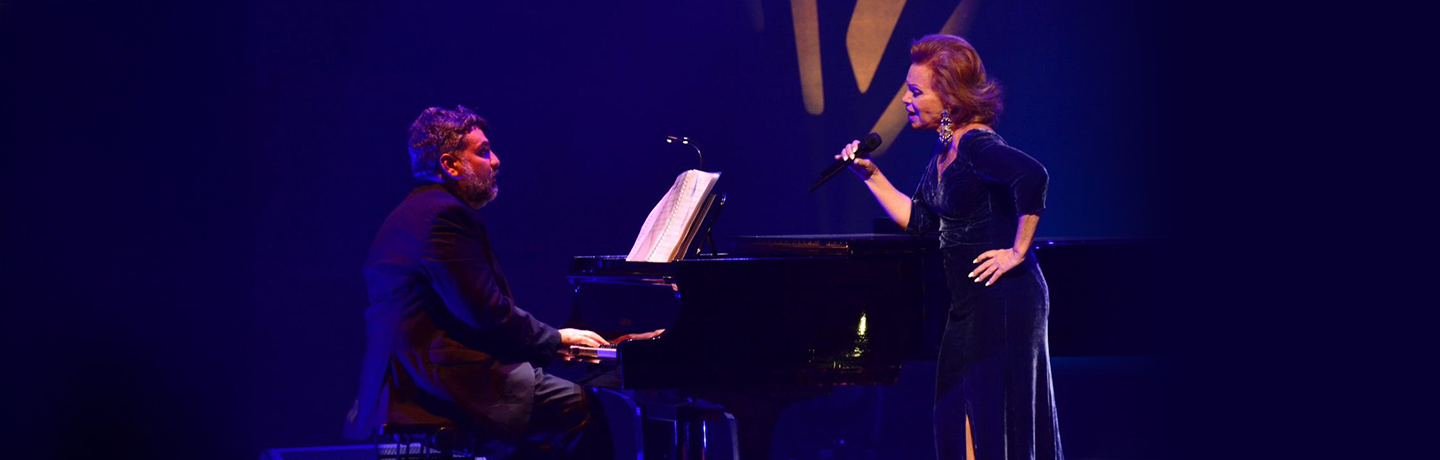
Julio Awad next to Paloma San Basilio.
The musical director: beyond the score
The image of the musical director as a mere executor of a score is insufficient in the context of musical theatre. Music is not fixed: it depends on the performer’s breathing, the pulse of the scene and the reaction of the audience. For Awad, tempo is not imposed but continuously adjusted during each performance. Musical direction thus becomes an act of listening rather than control —a constant negotiation between pit and stage.
A singer doesn’t sing the same every day. Energy changes. I follow the performer; I never force them. The day I force them, it becomes unnatural and I ruin the scene. It’s a conversation —sometimes conscious, sometimes tacit. I listen to the singer, the orchestra and the audience. You hear the audience in applause and in silence —maybe someone crying because you suddenly stopped the orchestra and a silence appears. That’s where emotion emerges. It can’t be mechanical: every performance is different.
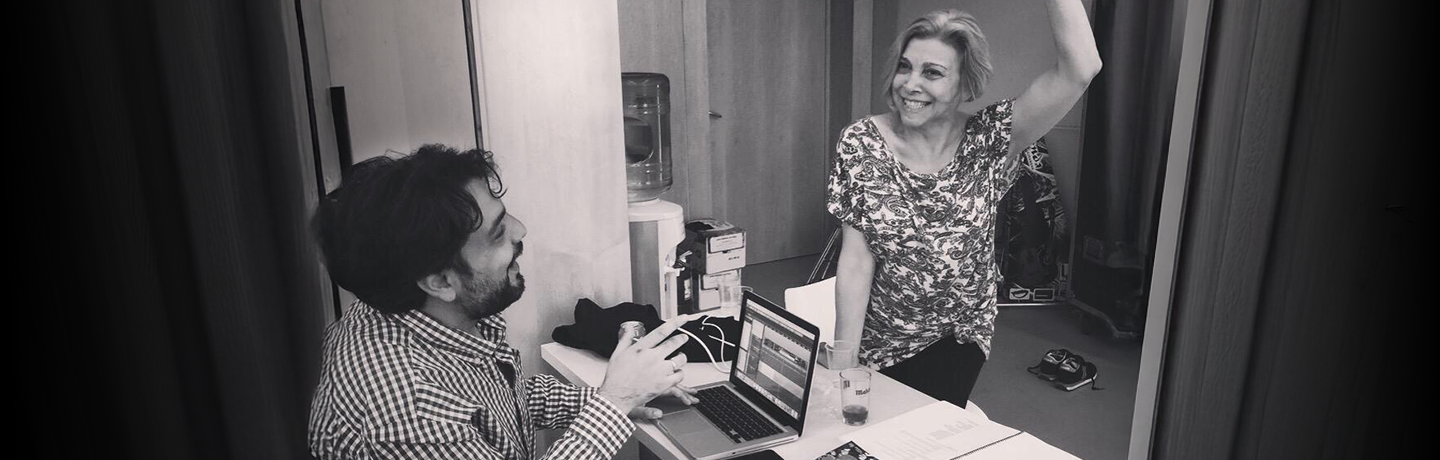
Julio Awad next to Kiti Mánver.
The preparatory work: transmitting experience and emotion
The staging is only the visible part of a long preparation process with cast and orchestra. Before each performance most decisions have already been made —and precisely for that reason the musical director disappears during the show. For Awad, this meticulous preparation is not an end in itself but a means toward a constant objective in all his projects: putting the work at the service of the performer, whether in musical theatre, concerts or audiovisual work.
For me the essential thing is the performer’s comfort —that they feel comfortable, valued and above all shine in what they do, even if it’s a very short moment. Musicals are a chain of scenes; all of them matter and must feel that way. In film, in concerts —everywhere— it’s important to want to tell the audience something new in the way the show is approached.
In his philosophy, directing also means transmitting an emotional understanding of what is being told. Preparation is not only about fixing tempos or dynamics but about generating a shared framework of meaning for the cast.
Interpretation does not emerge from the score but from the lives of those performing it. That is why much rehearsal time is devoted not to repeating music but to understanding what story is being told and from where. For Awad, this is where the difference lies between good musical direction and memorable musical direction.
We can’t forget we’re doing theatre — that’s why it’s musical theatre. You have to put your experiences, your life and what you feel at the service of the audience and the artist.
If the performer doesn’t yet have the life experience to tell the story, the director must transmit it — explain what is really happening and what should sound.
That’s the difference between correct execution and something truly masterful.
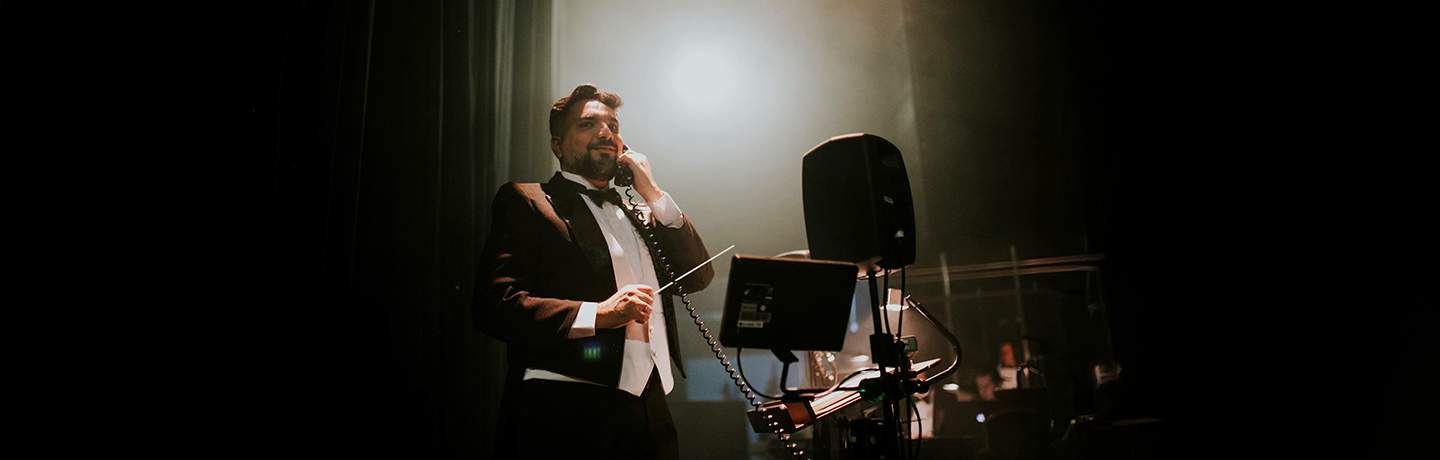
Julio Awad in the pit of Sunset Boulevard.
The consolidation of the genre
This working method also reflects the evolution of the genre itself. When Awad arrived in Spain twenty-six years ago, he coincided with the arrival of major international productions. Since then he has witnessed a structural transformation of the sector. Theatre has become a sustained cultural phenomenon, with its own audience and a generation of performers approaching the genre vocally and vocationally.
The change has not only been quantitative but also educational. Where once specialised performers were scarce, auditions now receive thousands of candidates trained specifically in musical theatre, both in national schools and international institutions. The proliferation of productions has been accompanied by unprecedented access to references: recordings, international productions available on digital platforms and the ease of travelling to cities such as London or New York have expanded the aspirational horizon of new generations.
This evolution has also affected the technical profile. Contemporary musical theatre requires performers capable of singing, acting and dancing, but also multi-skilled musicians — instrumentalists doubling saxophone and flute, for instance — something far less common in the local market two decades ago. For Awad, this growth is not merely a trend but the consolidation of a stage language that has found its audience and, above all, its professionals.
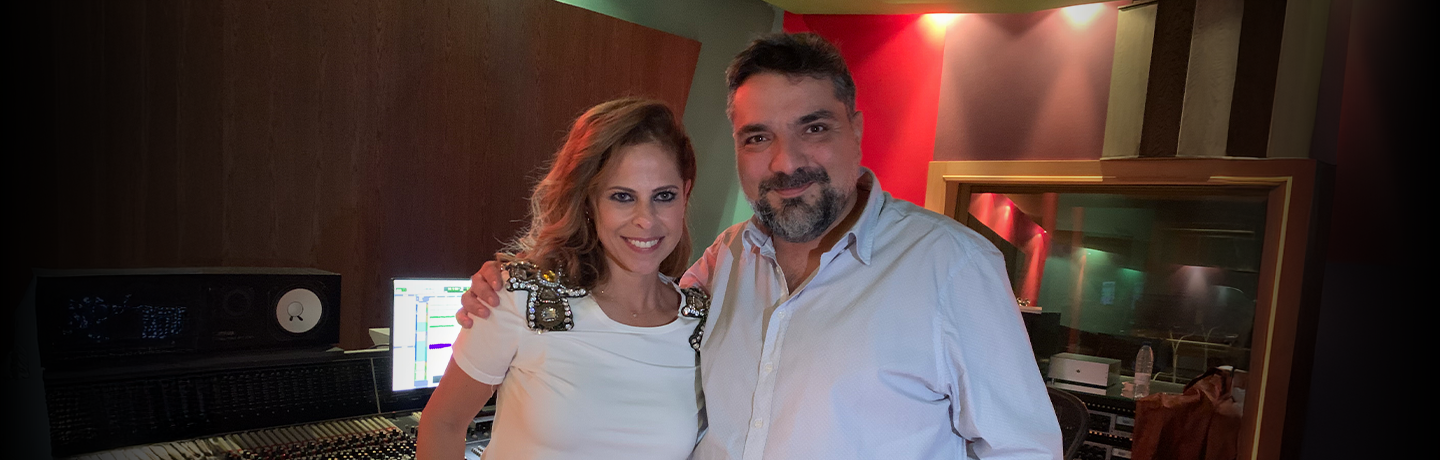
Julio Awad next to Pastora Soler.
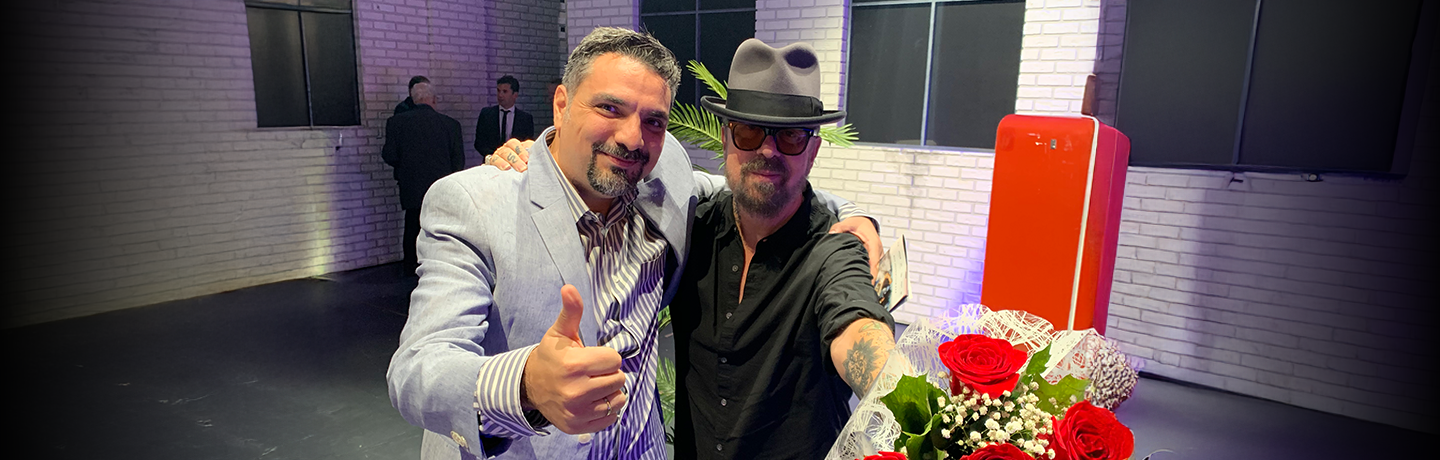
Julio Awad next to Dave Stewart, composer of Ghost.
The Phantom of the Opera: intervening without altering
This evolution has also changed the nature of the musical itself. If the genre was once associated mainly with vocal display and large spectacle, today very different relationships between music and dramaturgy coexist.
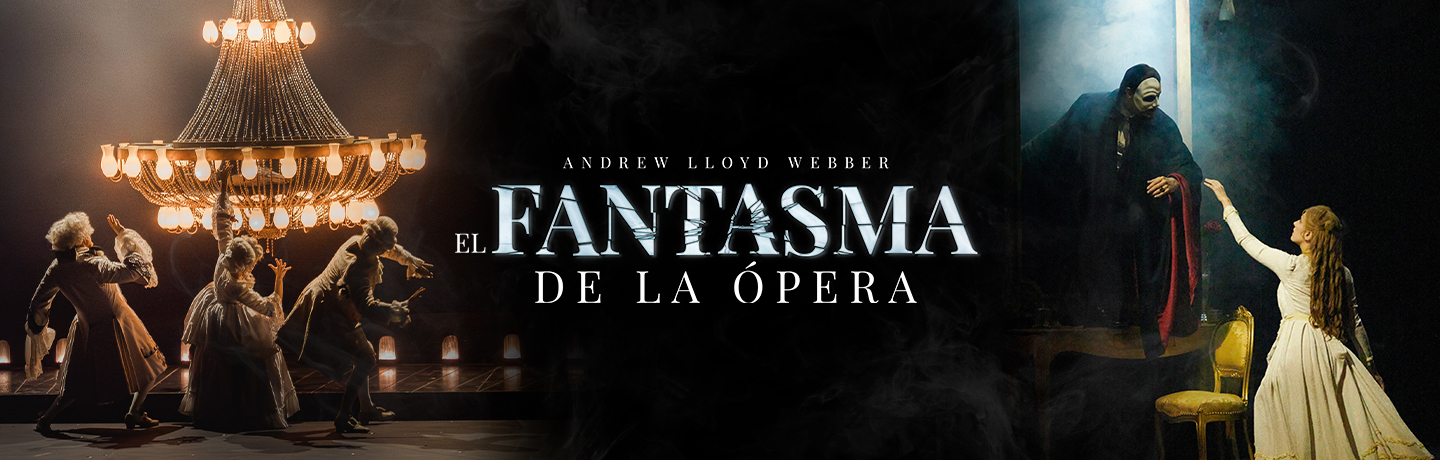
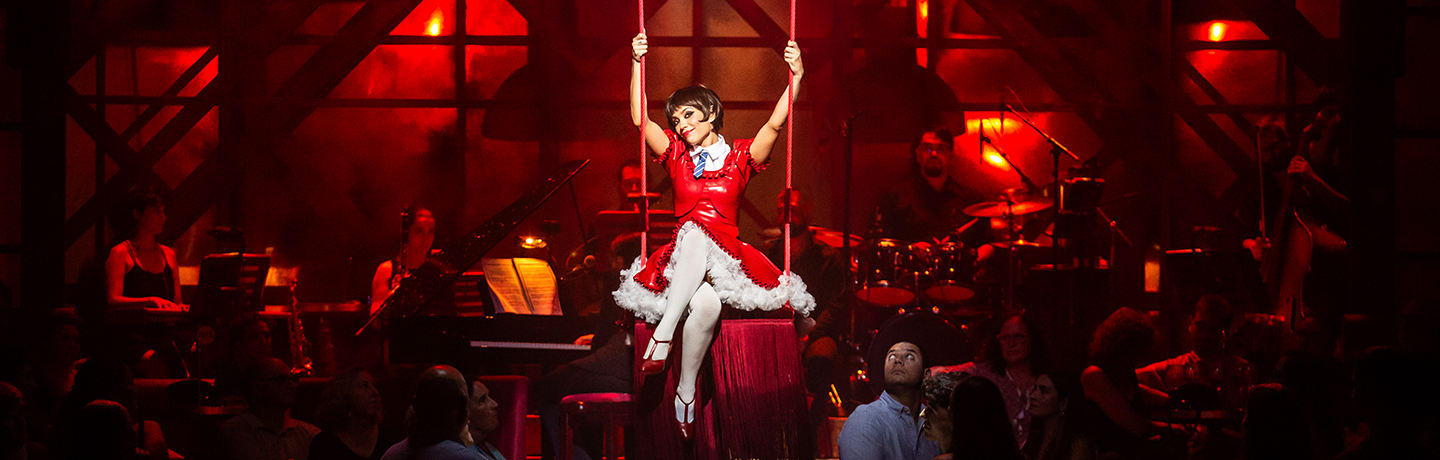
The difference becomes particularly visible when comparing two productions Awad has recently directed: The Phantom of the Opera and Cabaret.
Although they belong to the same genre, they require almost opposite musical approaches.
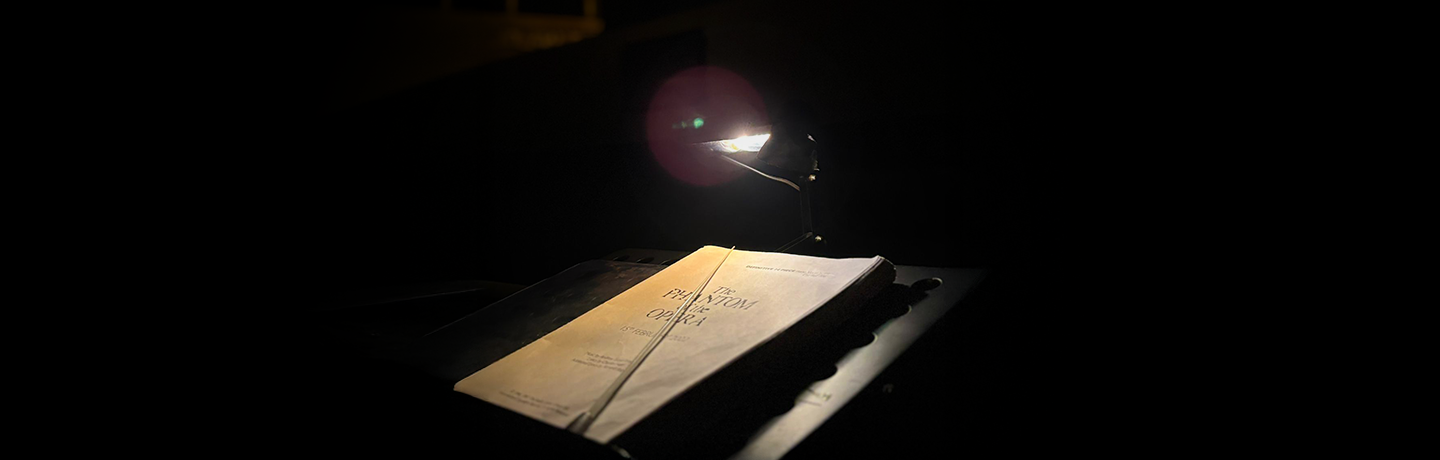
Conductor’s podium of The Phantom of the Opera.
What room for manoeuvre exists when working with one of the most iconic scores in musical theatre?
The margin lies mainly in tempos and silences. The music must be respected — that was agreed with Andrew Lloyd Webber — but English isn’t the same as Spanish.
What works fast in English doesn’t work the same in Spanish because the audience needs to understand the text. Sometimes one extra second of silence marks the difference between a correct direction and an excellent one.
I remember with Gerónimo Rauch at the end, when the Phantom turns back toward Christine — there were performances where he sped up enormously without looking at us and I followed him. It created brutal tension: the audience thought he was going to kill her. That’s where you handle the show.
You can’t change the score, so your playground is cadence, timing and waiting.

Julio Awad holding the Talía Award, honoring his work as musical director of The Phantom of the Opera.
In a work embedded in the collective imagination after more than three decades of international productions, the challenge was to offer a version that still felt distinct — and capable of moving audiences anew. On this, he explains:
Everything was complex. We had to figure out how to turn something around that has been running for over thirty years, that everyone knows, and still offer a different perspective — above all, one that could move people. We focused on the details, trying to extract everything from them: the solos, the violins… embracing a ‘less is more’ approach. We spent nearly a month in New York with Federico Bellone thinking about how to approach it. Then, once we arrived at the theatre, everything changed. The direction and the staging transformed the piece, and even English audiences were surprised.
Working on a closed material requires millimetric intervention without altering the piece: musical direction becomes an active restoration, bringing the work closer to new sensitivities through almost imperceptible changes.
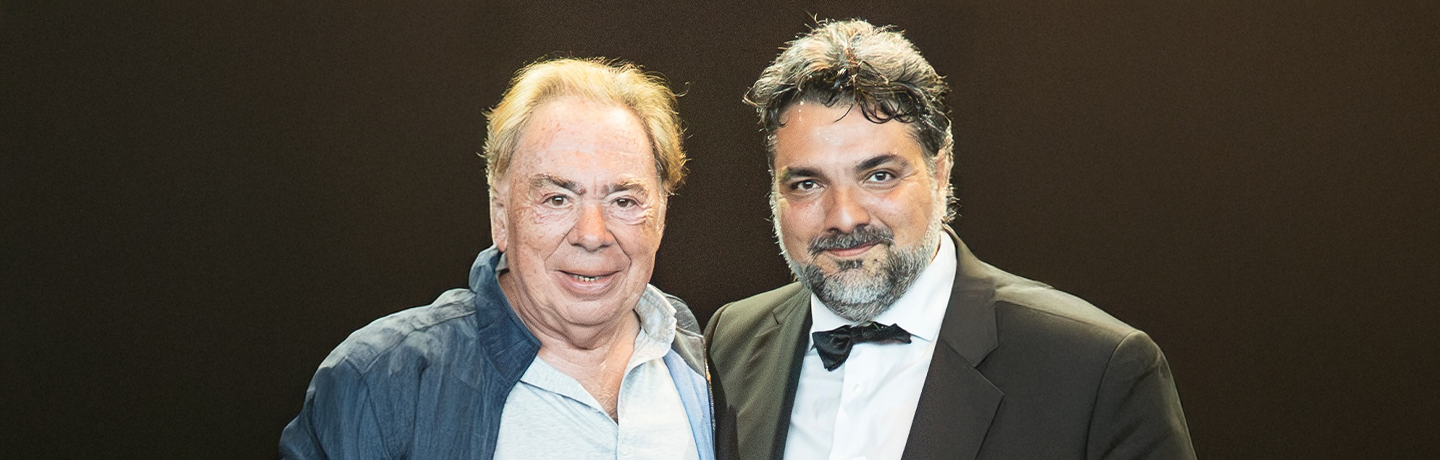
Julio Awad next to Andrew Lloyd Webber.
In Cabaret, every night you have to break yourself for it to work
Cabaret proposes the opposite approach, marked by its experiential dimension. Here the orchestra does not merely accompany the action — it is part of it. Musicians become dramatic presence, and what is required of them changes accordingly.
Musicians need mastery of jazz and, if someone didn’t have it, I trained them to get it. Same with the singers. Cabaret requires having lived. If I saw someone very young, I tried to transmit it — even with humour.
There was a tango singer, Roberto Goyeneche. A young guy told him he didn’t understand tango, and Goyeneche replied: ‘Want to understand tango? Live and suffer.’
It’s the same in Cabaret: it’s a story about suffering. You must be aware of what’s happening so the audience perceives that decadent point. The orchestra is beautiful — yes — but not only that. There’s something in the atmosphere; I keep you constantly caught with the music. In Cabaret, every night you have to break yourself for it to work.
Working with emblematic titles like Cabaret means facing enormous pressure.
It’s the hardest thing there is, simply because of comparison. There are countless versions and now I have to find how to make it different. What really makes the difference? Putting your heart into what you do without trying to show off. Put your joys and your tears into what you’re about to do — that’s the only way to move people. If you operate from ego, you achieve nothing.
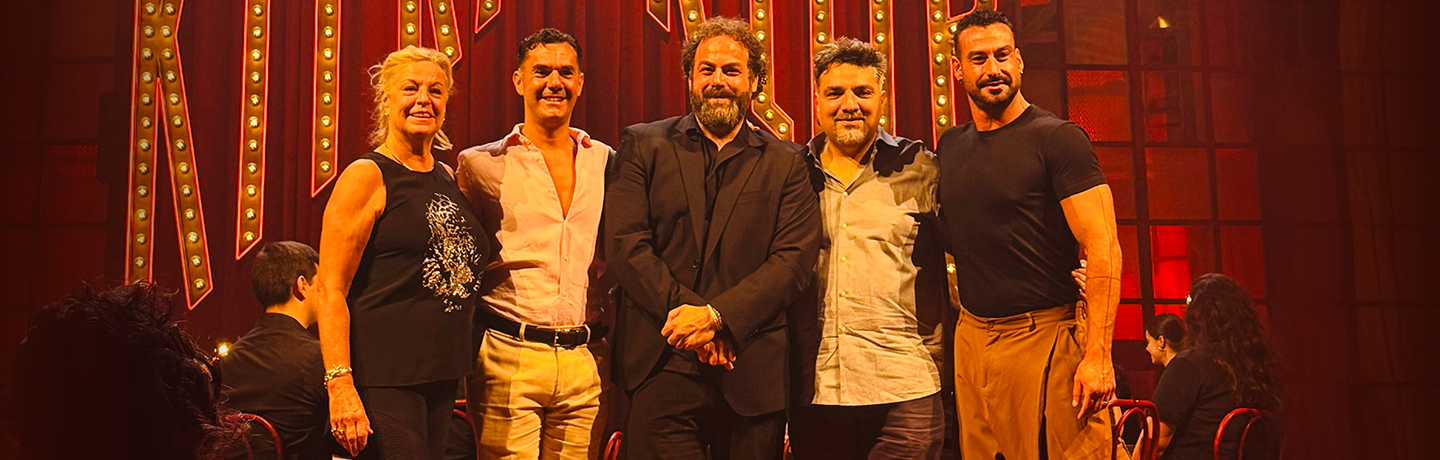
Creative team and producer of Cabaret. From left to right: Gillian Bruce, Federico Bellone, Iñaki Fernández, Julio Awad, and Felipe de Lima.
Ego, limits and teamwork
Beyond music and interpretation, maintaining a production also means managing people: egos, temperaments and relationships can determine the success of a production.
Ego is the root of all professional mistakes —putting yourself before a production or a show. And the other big mistake is character. I always say: they hire you for your talent and fire you for your character. Music is teamwork —if you want to be a soloist, go elsewhere.
For Awad, awareness of limits is as important as technique. Every decision and every instruction affects the performer’s experience —and therefore the audience’s.
The role of the musical director goes beyond musical quality. It’s also about how you handle the people you work with. You can seriously damage an actor’s career; at that moment the director is an authority figure. Let’s summarise it: mental health. You must be aware you’re working with people who can be deeply affected by what you say or do.
Like any creative craft, musical direction navigates between technique, sensitivity and teamwork. In an environment of growing entertainment supply, Awad insists the only way to move and connect with an audience is to put your heart into everything you do.
By the LETSGO Pen, Claudia Pérez Carbonell, on February 27th, 2026