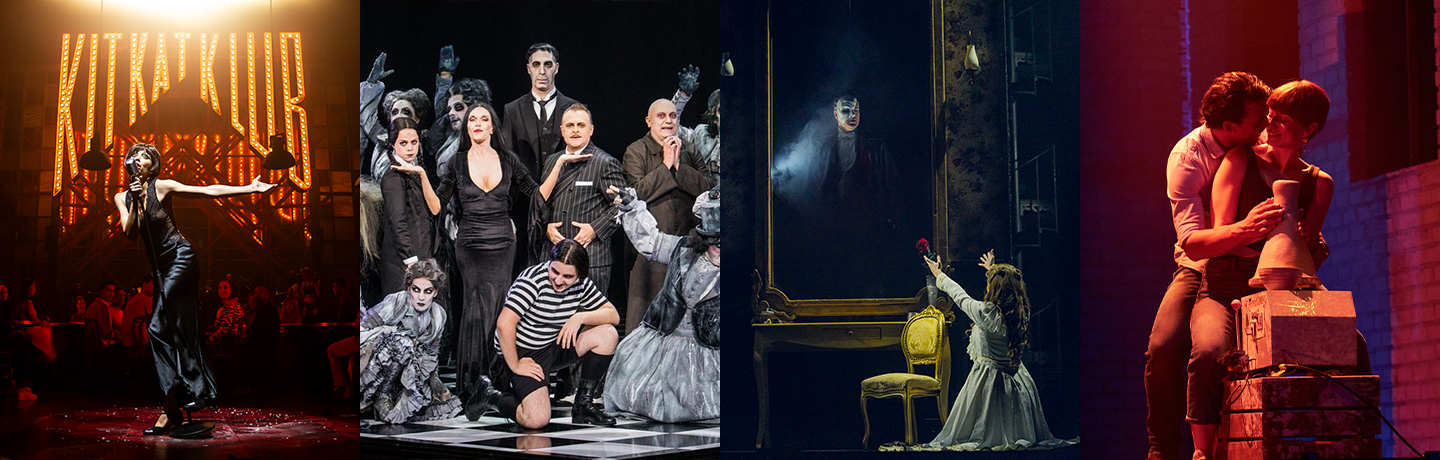

From Cabaret Chic Casual to Dark Glamour and Vintage Burlesque, a contemporary take on stage costume translated to the street and night.
The preferred space of the artistic bohemia, Cabaret, was unimaginable without dim lighting, mystery, and a palette dominated by dark tones. The costumes complemented —and reinforced— this atmosphere of contained sensuality through textures and shapes: satin, sequins, feathers, corsets, lace, tulle, or velvet. Color gravitated around black, burgundy, and gold, with occasional bursts of white intended to contrast, unsettle, and provoke.
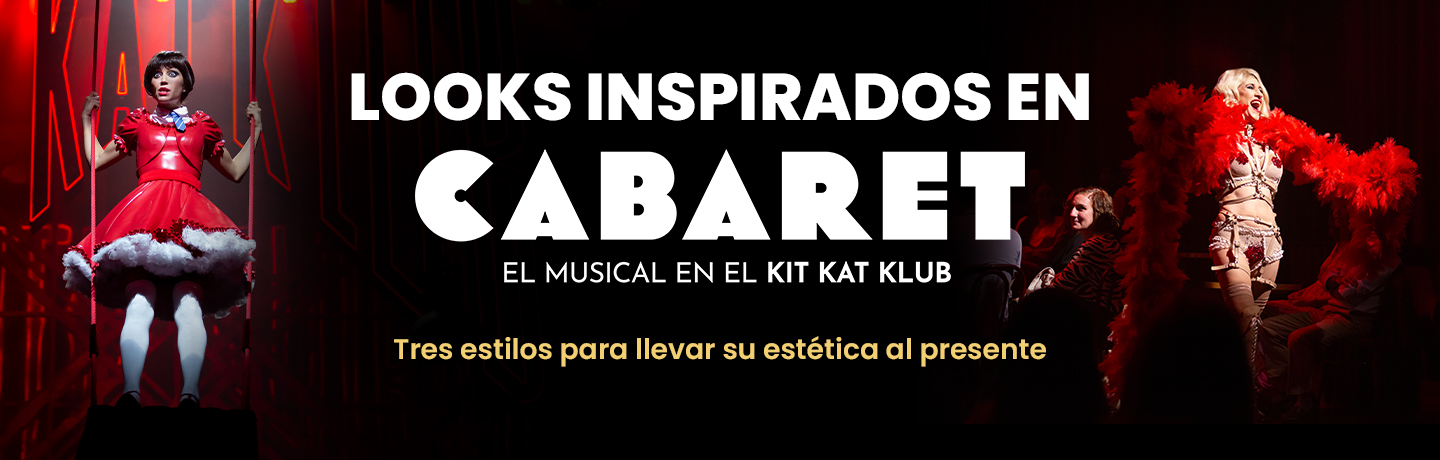
This tension between darkness, desire, and modernity also runs through our production of Cabaret. Far from a literal period reconstruction, the staging incorporates contemporary materials and codes —like latex or leather— to update the Kit Kat Klub’s imagery and connect it to a current aesthetic sensibility.
This is, without doubt, a conscious visual decision: to reinforce the ideas of body, control, and power that have always been present in the work, translated into a language recognizable to today’s audience.
The same exercise of reinterpretation allows Cabaret’s aesthetic to continue filtering into contemporary fashion as a constant source of inspiration. At this intersection of past and present, three particularly relevant readings —or styles— emerge…
Cabaret Chic Casual
Subtlety as a daily code
This reading of the Cabaret imaginary rests on a well-known paradox in contemporary fashion: effortless aesthetics are rarely spontaneous. Cabaret Chic Casual doesn’t pursue simplicity, but rather the sensation of lightness within a deliberately constructed ensemble.
On one hand, the style is built through layering: overlapping skirts, tulle transparencies, polka dots, volumetric pieces, and gloves. Small feather accents complete a look that appears casual but is carefully considered.
On the other hand, this logic extends to seemingly more straightforward combinations. Jeans and blazers —two deeply everyday pieces— are transformed with pearl embroidery, sparkling applications, or cabaret-inspired accessories that alter their original reading. Everything responds to a precise aesthetic choice.
The palette remains restrained to allow for texture play. Black, muted tones, off-whites, subtle pops of color, and dark shades support a silhouette that moves between the feminine and the ambiguous, the everyday and the theatrical.
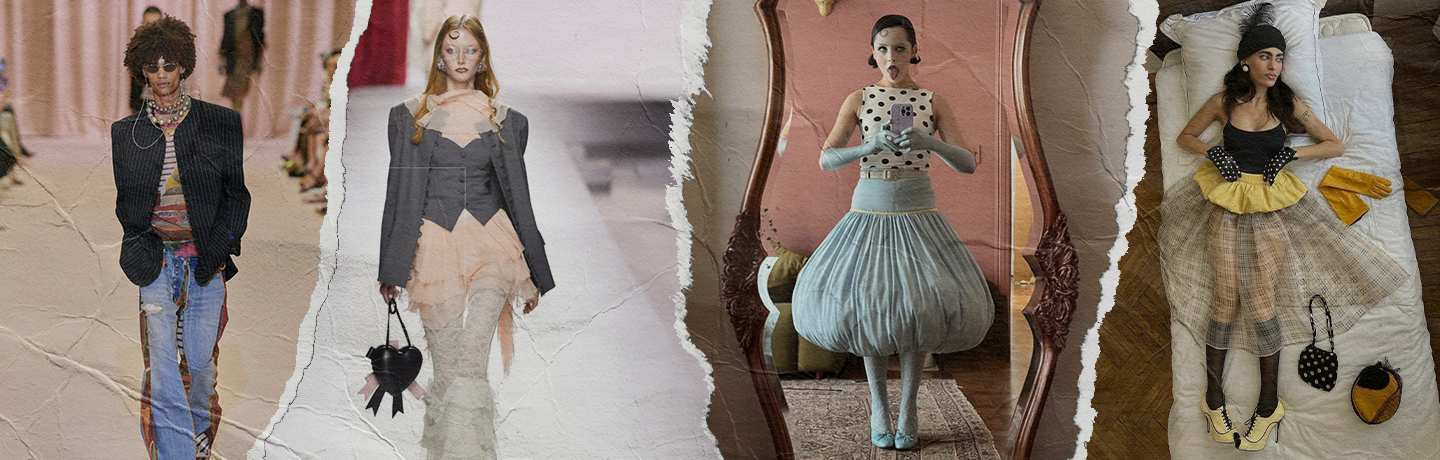
A curated selection of images featuring celebrity, influencer, and runway looks, where Cabaret’s aesthetic is reinterpreted through contemporary silhouettes, contrasting materials, and a modern reading of stage costume.
Dark Glamour
Night as a visual construction
Dark Glamour doesn’t arrive as a new trend but as a return. In recent years, celebrities and style influencers have gravitated back to this aesthetic, marked by the blend of brutalism and sensuality, reclaiming fashion as a statement.
Bold silhouettes, asymmetric cuts, and a palette dominated by blacks, charcoals, and dark tones define this register. Color appears sparingly, almost strategically, while materials such as leather, latex, satin, and sheer fabrics provide controlled visual intensity. In its contemporary iteration, Dark Glamour dialogues with Gothic and Victorian references, but through a more refined, conscious lens.
In the Cabaret universe, this style connects directly to its nocturnal and political dimension: elegance as a form of power, darkness as an aesthetic choice.
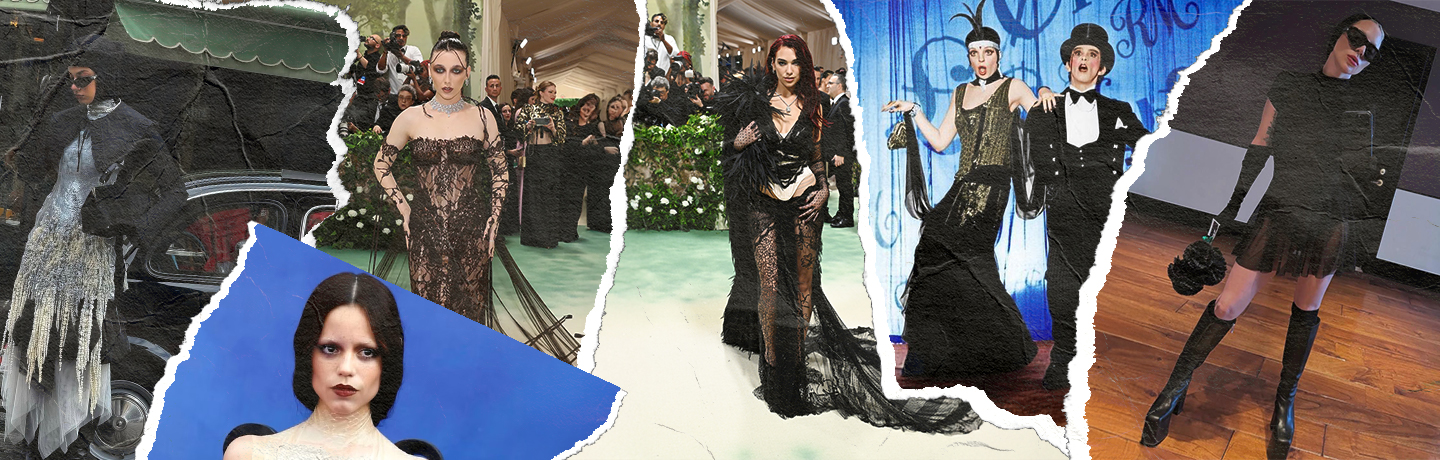
A curated selection of images featuring celebrity, influencer, and runway looks, where Cabaret’s aesthetic is reinterpreted through contemporary silhouettes, contrasting materials, and a modern reading of stage costume.
Vintage Burlesque
The past as an aesthetic tool
Vintage Burlesque looks to the 1920s and ’30s without falling into literal reconstruction. It takes elements from classic burlesque and period costumes —corsets, stockings, suspenders, menswear shirts— and reinterprets them through a contemporary lens.
Here, mixing is essential. A piece clearly inspired by the past coexists with a modern one to avoid costume-like effects and create its own visual language: corsets turned into tops, high-waisted trousers paired with technical fabrics, oversized white shirts that blur gender boundaries.
This style aligns with the more playful and ironic side of Cabaret, where provocation is understood as aesthetic intelligence rather than excess. Dressing from the past, in this case, serves as a reminder that certain tensions around body and power remain fully present today.
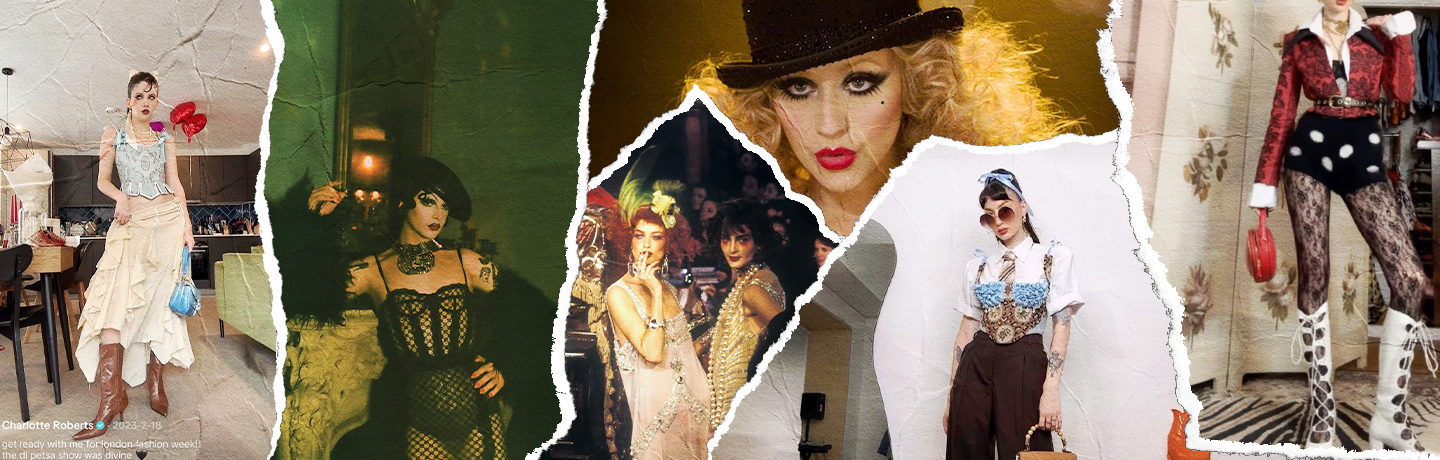
A curated selection of images featuring celebrity, influencer, and runway looks, where Cabaret’s aesthetic is reinterpreted through contemporary silhouettes, contrasting materials, and a modern reading of stage costume.
Cabaret as Attitude
The Cabaret universe continues to function as an aesthetic reference precisely because it exceeds its own limits and is not confined to costume alone. It was—and still is—a way of looking at the body, power, and staging.
Cabaret Chic Casual, Dark Glamour, and Vintage Burlesque are simply different registers of the same idea, all orbiting around reinterpretation as a creative engine. Rather than fixed categories, these styles operate as possible readings of Cabaret’s aesthetic imaginary—patterns identified in contemporary fashion and in current scenic re-significations.
Layering, contemporary materials, altered everyday garments, and archives from the past activated through a present-day lens all respond to the same logic of mixture and conceptual relocation.
Cabaret, then, can be understood as an attitude rather than a style. Its codes now appear in everyday dress, often unconsciously. No longer confined to the night or to a specific space, this shift reveals a broader condition of contemporary aesthetic freedom: the absence of rigid frameworks that restrict certain garments to particular times, contexts, or scenarios.
Corsets and satin are no longer exclusive to the night; sheer fabrics integrate into daily wear. This displacement is not accidental. Traditional dress codes are increasingly questioned, and the boundaries between the theatrical and the everyday, the daytime and the nighttime, the acceptable and the provocative, continue to blur.
Within this same movement, long-established gender divisions tied to clothing also begin to erode. Garments, fabrics, and silhouettes that for decades functioned as markers of femininity or masculinity are released from that normative role. Oversized shirts, corsets, stockings, lace, or embellished blazers now circulate without fixed attribution, activating a more ambiguous and fluid aesthetic.
At this intersection, Cabaret ceases to be a historical reference and becomes an active language. Getting dressed no longer means adapting to a closed context, but rather appropriating codes, mixing them, and re-signifying them.
By the LETSGO Pen, Claudia Pérez Carbonell, on January 15th, 2026