
The return of The Addams Family musical to the stage: a first look at its legacy and its new production.
Normality is an illusion; what is normal for the spider is chaos for the fly.
What is “normal”?
The return of the Addams Family to the stage reopens a question their universe has been challenging for decades: the idea of normality. Their reappearance forces us to ask what we really mean by “normal” —or, more precisely, whether such a thing has ever truly existed.
Few cultural properties have moved across so many eras and formats without losing their identity. It is striking that a family built on “anomaly” has managed to endure across generations without losing coherence, consistently finding new ways to fit in.
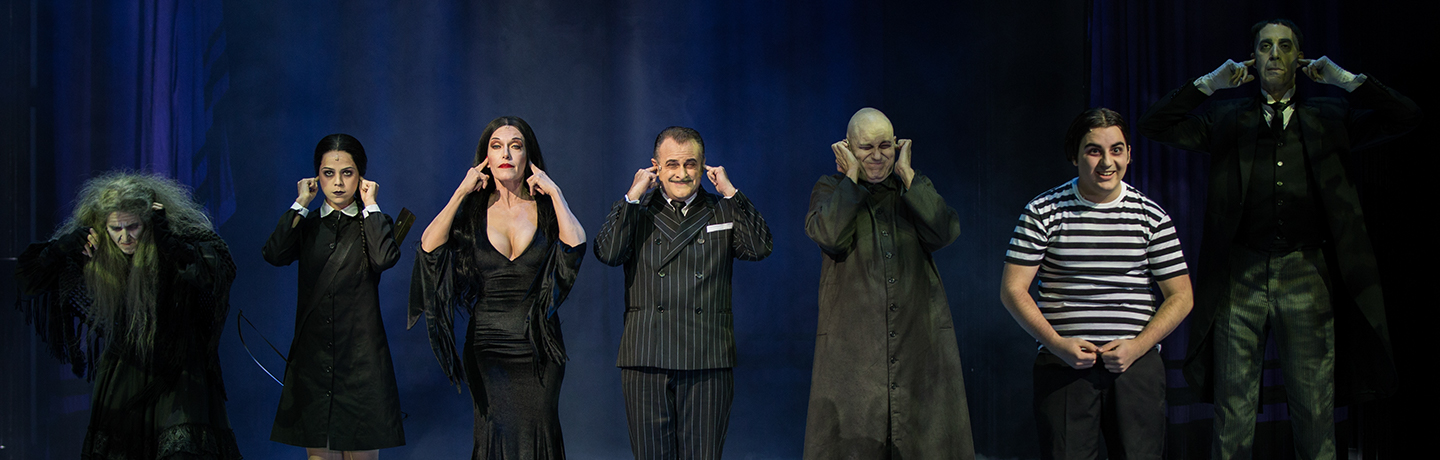
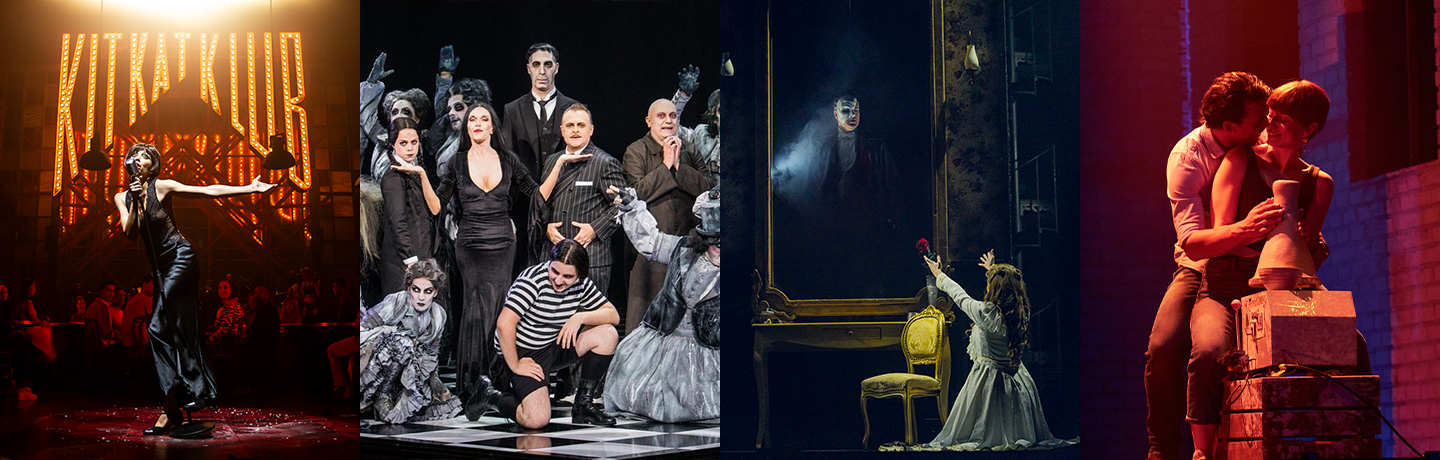
Images from the 2017 production of The Addams Family. Photo: LETSGO.
Charles Addams: the origin
Yet their relevance is not simply the result of nostalgia. If the Addams still resonate today, it is precisely because of their capacity for transformation: their ability to move across eras, languages, and formats without betraying their essence.
That capacity has a very specific origin. Before becoming a transmedia phenomenon, the Addams were the product of a singular way of seeing the world: that of Charles Addams.
From an early age, Addams showed an unusual fascination with the macabre —exploring cemeteries, drawing skeletons on the walls of his neighborhood— a sensibility he later developed through his artistic training at institutions such as Colgate University, the University of Pennsylvania, and the Grand Central School of Art in New York. In 1933, he sold his first cartoon to The New Yorker, beginning a career that would exceed 1,300 published pieces.
By 1938, the first sketches of that eccentric, funeral-toned family began to appear, still loosely defined, functioning as a parody of the American middle class. These characters displayed a peculiar delight in the macabre and a fascination with the unsettling. Their internal logic seemed to invert the familiar: turning the sinister into something everyday, and the everyday into something deeply strange.
Their formalization came later, in 1964, when, together with producer David Levy, these characters made the leap to television. It was then that they acquired their definitive identities —Gomez, Morticia, Wednesday, and Uncle Fester— and that the Addams universe consolidated itself as a recognizable cultural imaginary, ready to expand far beyond its original format.
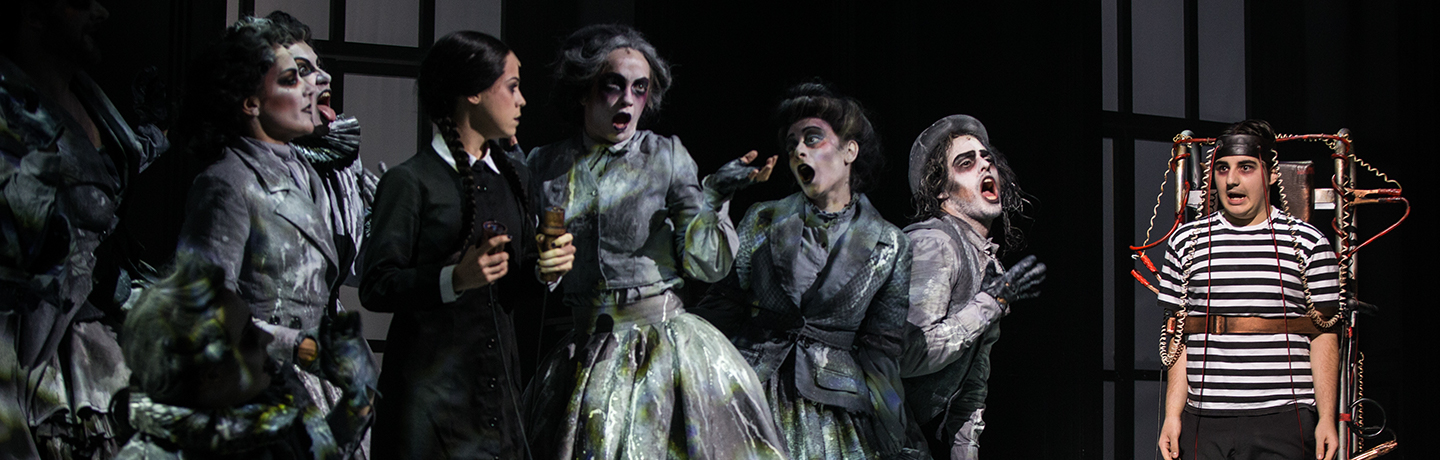
Images from the 2017 production of The Addams Family. Photo: LETSGO.
From cartoon to cultural phenomenon
From that point on, the Addams began a journey across different media without losing their identity. The television series of the 1960s turned them into a widely recognizable phenomenon, establishing a collective image of the family that would soon evolve.
The film adaptations of the 1990s reinforced their aesthetic dimension and refined their visual universe, consolidating an iconography that still functions as a reference today. Later, their transition to musical theatre marked yet another reformulation, translating that balance between the macabre and the everyday into a stage language where exaggeration, rhythm, and musical composition expanded their expressive potential.
The Addams universe has continued to find new ways to engage with the present. The recent success of Wednesday has once again placed the family at the center of popular culture, connecting with a generation that did not necessarily grow up with previous versions. In this reinterpretation, the internal logic remains intact, preserving a perspective that continues to use the strange as a way of questioning the established order.
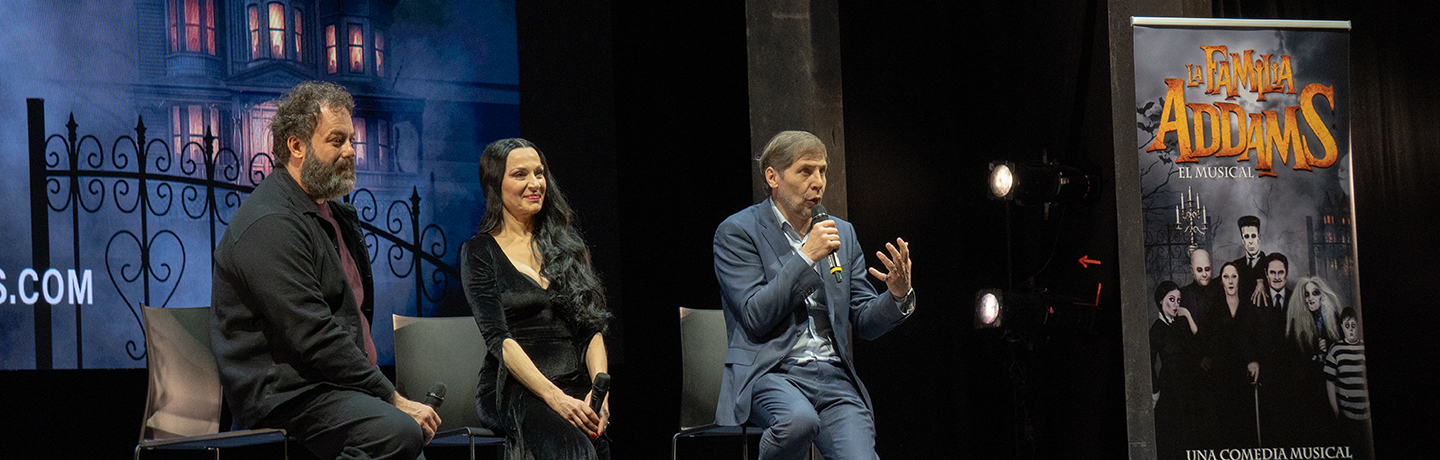
From left to right: Iñaki Fernández (CEO of LETSGO), Natalia Millán (as Morticia Addams), and Darío Regattieri (CEO of beon.Entertainment). Photo: LETSGO.
Back on stage: reinterpreting the Addams today
In this context, bringing The Addams Family back to the stage is not simply about revisiting a familiar title, but about engaging with a work that has repeatedly proven its ability to be reinterpreted. Each new version carries with it an inherited imaginary, but also the demand to speak to the present.
The new production set to premiere this season embraces precisely that challenge: to explore what that balance between darkness and the everyday means today, and how the tradition of the Addams universe can connect with the sensibilities of a new generation.
Creative decisions —from scenography to musical treatment— point in that direction: a revision that updates the codes without breaking from the essence. At a time when the figure of Wednesday Addams has reshaped how new audiences access this universe, the stage becomes a privileged space to expand that experience and restore its physical, shared dimension.
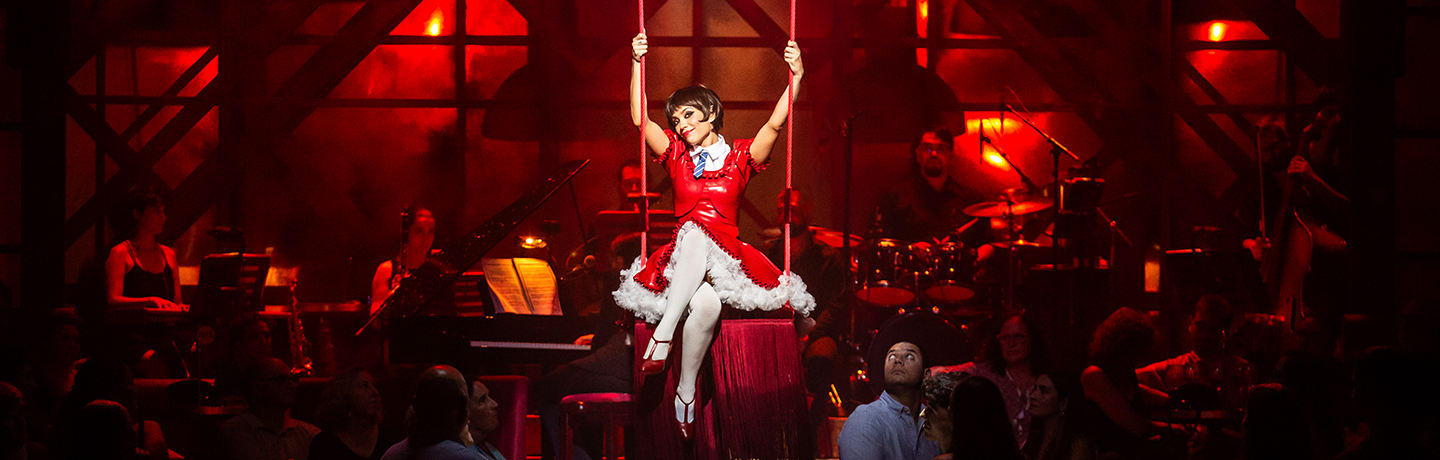
At the center of this reinterpretation is Natalia Millán, who takes on the role of Morticia through an approach that recovers one of the character’s defining traits: her sophistication. Far from caricature, her performance is built on restraint, precision, and an elegance that acts as a counterpoint to the chaos around her. The actress herself has highlighted the appeal of taking on such an iconic role, one deeply embedded in cultural imagination, yet still open to new interpretations.
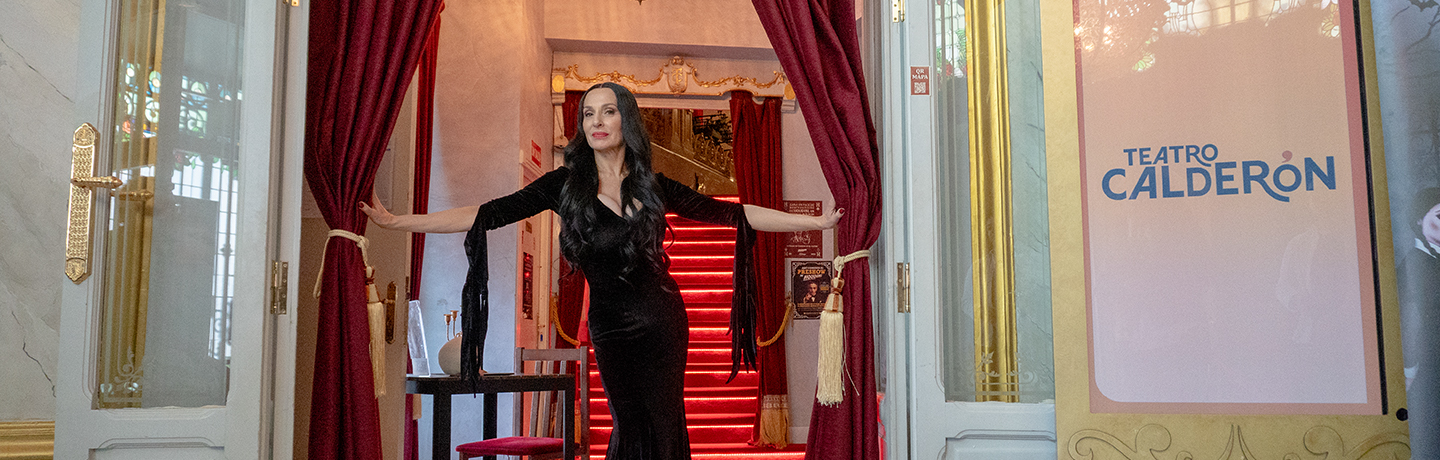
Natalia Millán as Morticia Addams. Photo: LETSGO.
Industrial context: a strategic return
The return of The Addams Family at this moment is no coincidence. Led by LETSGO and beon. Entertainment, the project combines artistic intent with industrial strategy: capitalizing on a well-established IP while repositioning it for new audiences.
In a sector where theatrical reboots and recognizable universes have become increasingly common, this musical fits into a broader trend that seeks to balance innovation and familiarity —appealing both to long-time fans and to those discovering the Addams through recent phenomena like Wednesday.
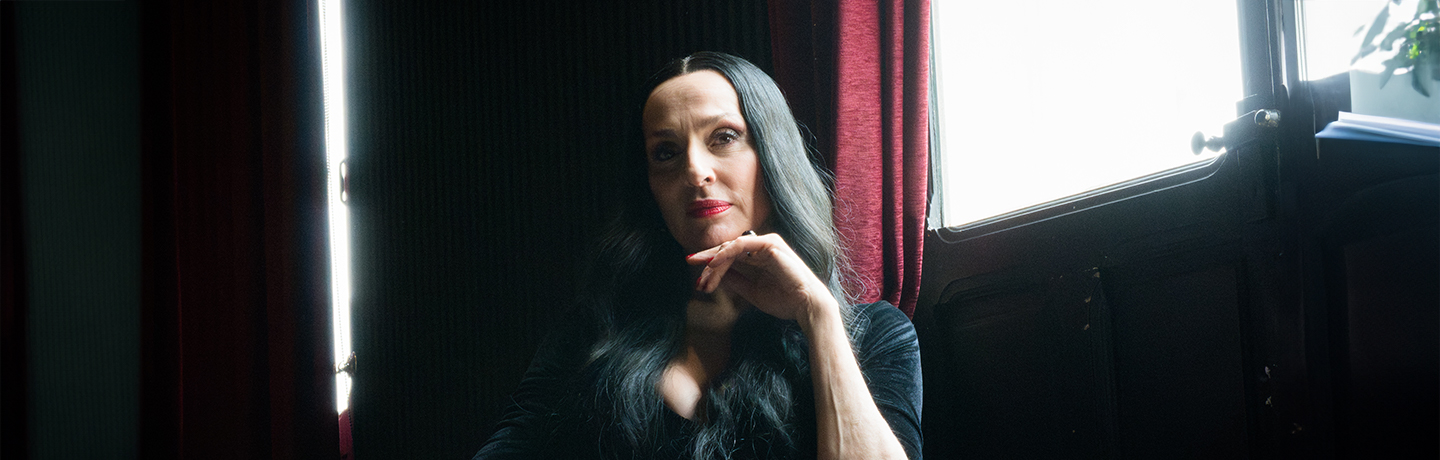
Natalia Millán as Morticia Addams. Photo: LETSGO.
Presentation and casting underway
On March 18, a press event was held, led by the CEOs of LETSGO and beon. Entertainment, who shared the first key insights into the project and details ahead of its September premiere. The event also marked the first time Natalia Millán appeared on stage fully transformed as Morticia Addams, speaking about the appeal of portraying a character she described as elegant, witty, and sophisticated, and firmly rooted in popular culture.
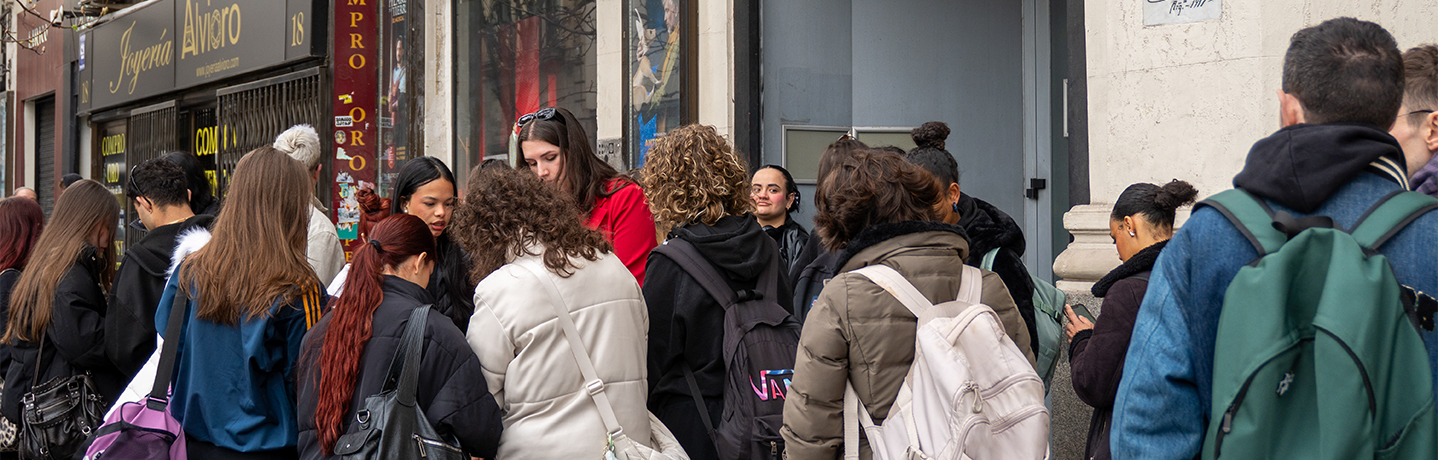
Applicants gathered in the line for the casting sessions of The Addams Family musical outside Teatro Calderón. Photo: LETSGO.
The presentation coincided with a crucial stage in the production process. Castings were taking place in the theatre itself, as the team searched for the performers who will complete the ensemble. From early morning, a long line of hopefuls gathered outside the Calderón Theatre, while inside, preparations for the presentation continued.
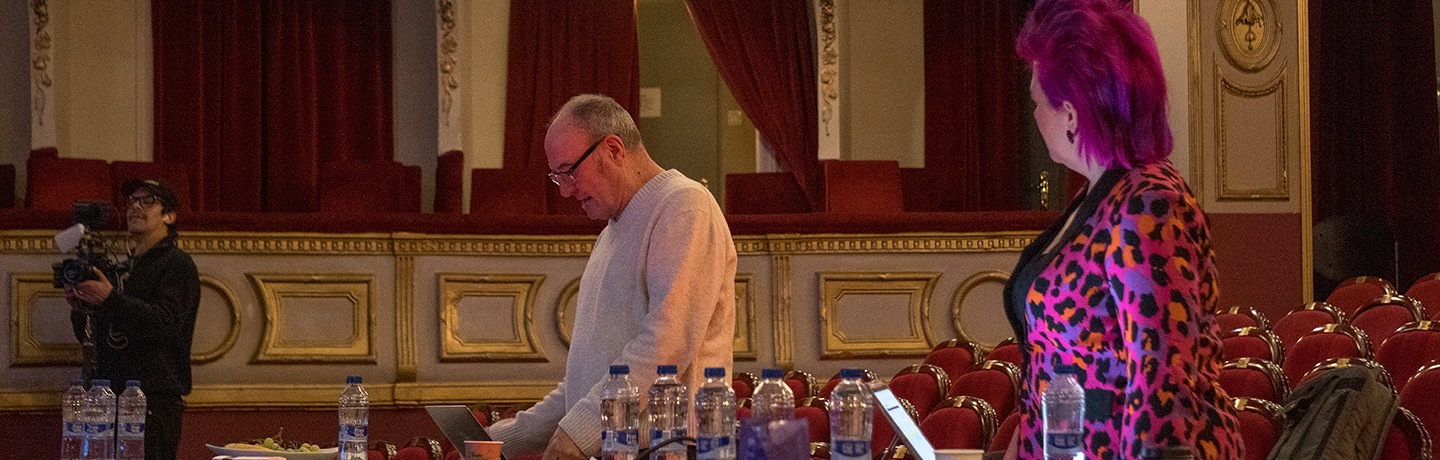
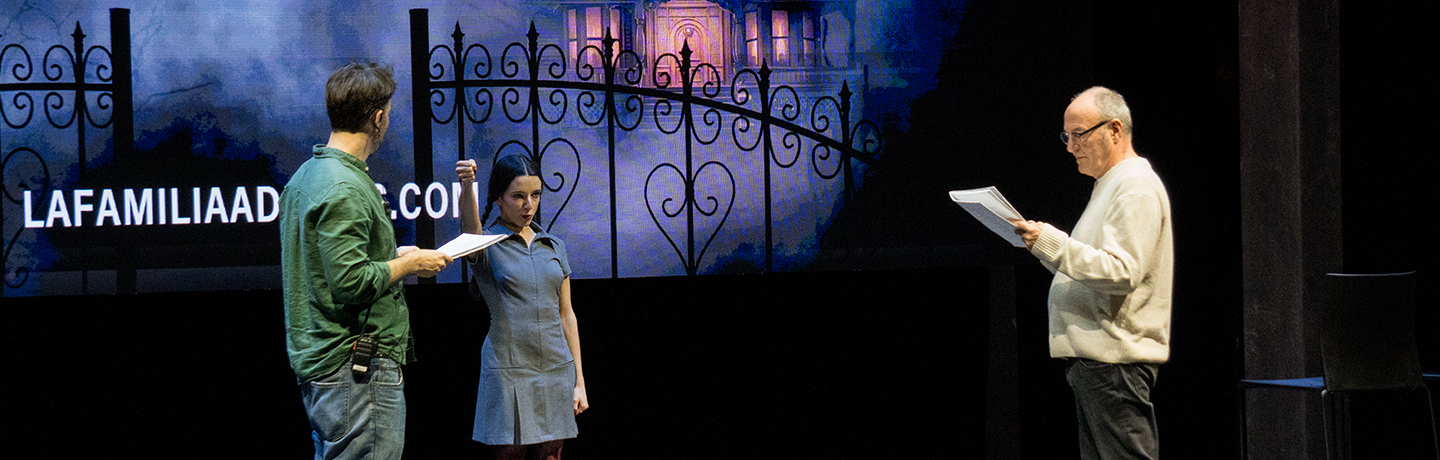
Casting sessions for The Addams Family musical. Photo: LETSGO.
During the event, producers also revealed elements of the staging, including a large-scale set dominated by the family home and an increased emphasis on special effects.
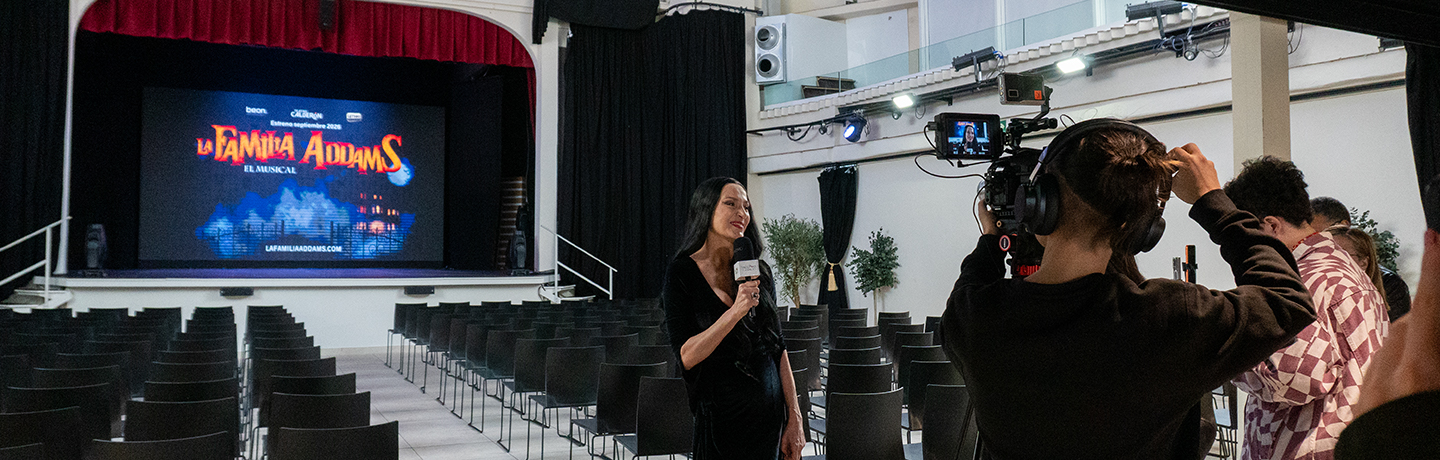
Natalia Millán as Morticia Addams during a media interview. Photo: LETSGO.
The Addams as a contemporary mirror
Ultimately, this return confirms something the family has demonstrated for decades: the Addams endure because, in many ways, the world is beginning to resemble them.
As explored in previous articles, we live in a time when the strange no longer unsettles. What once functioned as anomaly is now easily absorbed into the cultural mainstream, losing its ability to create distance or discomfort.
In this context, the Addams no longer function solely as an exception, but as a reflection. They are no longer the outsiders living on the margins; we have moved closer to their territory —and in doing so, they reveal the extent to which “strangeness” has ceased to be strange at all.
By the LETSGO Pen, Claudia Pérez Carbonell, on March 26th, 2026